The Gothic Quarter Barcelona is one of the best places in Europe to teach history on foot. In a few hours, students can see Roman columns, medieval squares and buildings that carry the marks of the Spanish Civil War. They can also discover that some “medieval” sights were built in the 20th century.
This guide outlines a short history walk through the Barri Gòtic, as locals call it in Catalan. You will learn what each stop shows, which questions to ask students and how to plan the walk with a group. At the end, we explain how a guided walk through Barcelona’s historic center fits into our 10-day Spain program. The exact route of that walk is set by the local guide and may not include every stop above.
A Short History of the Gothic Quarter Barcelona
The quarter sits on the oldest part of the city. The Romans founded a colony called Barcino here in the 1st century BC. It stood on a low hill, Mont Tàber, where Plaça Sant Jaume is today. The medieval city grew on the same site.
The name “Gothic Quarter” is newer than many visitors expect. In the years before the 1929 International Exhibition, the city restored and remodeled buildings to give the area a uniform medieval look. Researchers have since documented how much of today’s “Gothic” style comes from that period. That makes the quarter a strong case study in how cities present their own past.
A History Walk Through the Barri Gòtic
This route follows the city’s timeline from Roman times to the 20th century. The stops are close together, so the walk suits a morning or an afternoon.
Stop 1: Roman Walls at Plaça Nova
Start near the cathedral at Plaça Nova. Sections of the Roman wall are still visible here and along Carrer de la Tapineria. Ask students: why did a Roman town need walls, and what do they tell us about its size?
Stop 2: The Temple of Augustus
Four tall Roman columns stand inside a courtyard on Carrer del Paradís. They belonged to a temple from Barcino. Students are often surprised to find them hidden in a narrow street. This stop is a good moment to talk about how ancient sites survive inside modern cities.
Stop 3: Barcelona Cathedral
The Cathedral of the Holy Cross and Saint Eulalia was started in 1298. Its cloister was finished in 1448. The main facade looks medieval, but it was completed in 1913, based on an older design.
Inside the cloister live thirteen white geese. Tradition links the number to the age of Saint Eulalia, a co-patron of Barcelona, at her death. Her relics lie in the cathedral crypt.
Stop 4: Plaça del Rei
The royal palace buildings around Plaça del Rei are among the quarter’s genuinely medieval spaces. The Barcelona City History Museum (MUHBA) has sites in this area, including Roman remains. Ask students to compare this square with the cathedral facade. Which one is older?
Stop 5: The Bishop’s Bridge
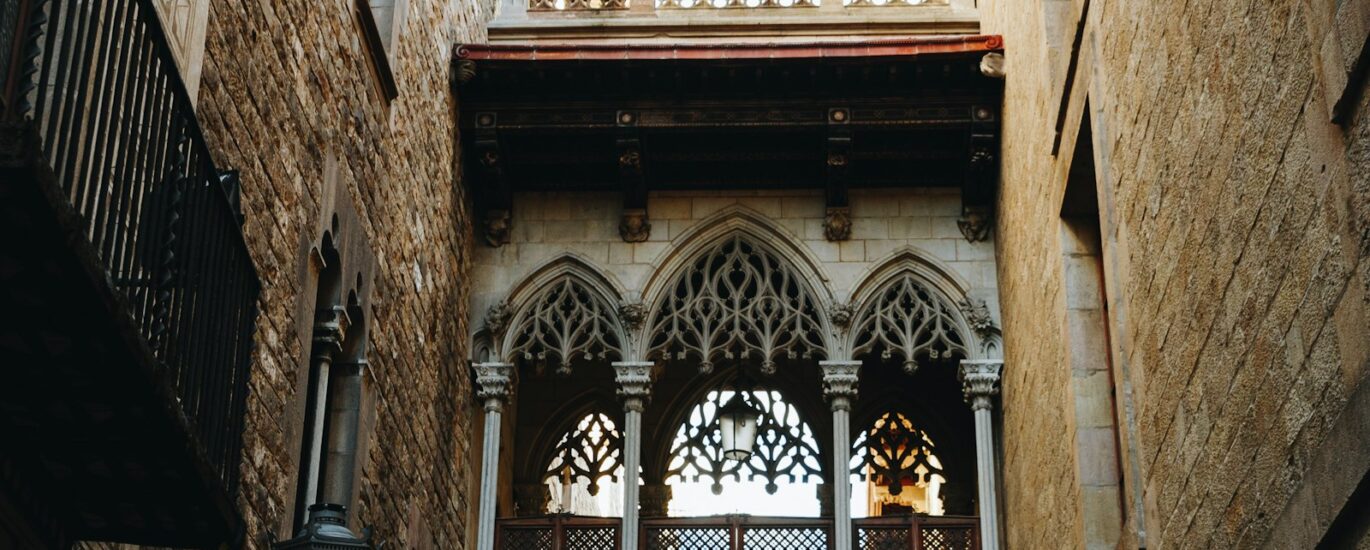
The Pont del Bisbe is a carved stone bridge over Carrer del Bisbe. Many visitors assume it is medieval. Architect Joan Rubió designed it in 1928. Use it to start a discussion about authenticity in historic places.
Stop 6: Plaça Sant Felip Neri
The church facade in this quiet square is marked by damage from an air raid on January 30, 1938, during the Spanish Civil War. The bombing killed 42 people, many of them children sheltering inside. Ask students to stay quiet here and reflect on the square’s history.
Stop 7: El Call, the Old Jewish Quarter
The narrow streets of El Call were home to Barcelona’s Jewish community until an attack in 1391. Close the walk here with a discussion of religious diversity and persecution in medieval Europe.
Planning Tips for Teachers
- Hire a licensed local guide. A guide brings the stories behind each stop to life and handles the route.
- Keep the group tight. The streets are narrow and crowded. Use a buddy system and agree on a meeting point at each stop.
- Protect belongings. Pickpocketing is common in busy tourist areas. Students should wear bags in front and keep phones zipped away.
- Respect working sites. The cathedral is an active place of worship. Brief students on quiet behavior and modest dress.
- Assign a task. Give each student a stop to research and present to the group on site.
Several Gothic Quarter streets also offer good things to do in Barcelona after the walk, such as visiting small museums or squares. For a wider view of the region’s heritage, share our list of top UNESCO sites in Europe. Spanish students will notice street signs in Catalan. Our guide to Castilian vs. Latin American Spanish helps them explore language variety in Spain and beyond.
Barcelona’s Historic Center in Our Spain Program
In the Spain Global Impact Fellowship 2027, Day 2 includes a guided walking tour of Barcelona’s historic center. The tour gives students context on how the city grew. The same day, groups visit Sagrada Familia and Park Güell.
The Barcelona days also include a day trip to Montserrat, a visit to the social organization Mescladis with a tapas cooking class and a bike tour of the waterfront. After the trip, a structured student travel reflection helps students connect what they saw to classroom work.
FAQ
Why is it called the Gothic Quarter?
The name comes from its medieval Gothic buildings, such as the cathedral. Much of the area’s uniform Gothic look was created during restorations in the early 20th century.
What is the oldest part of the Gothic Quarter Barcelona?
The Roman remains are the oldest. These include sections of the city wall and the columns of the Temple of Augustus, from the Roman colony of Barcino.
Is the Gothic Quarter good for a student walking tour?
Yes. The main stops are close together, and each one connects to a different period of history. A licensed guide helps groups move safely through the narrow streets.
Walk Through Barcelona’s History with Your Students
Barcelona’s old streets let students see more than two thousand years of history in a single walk. Our Spain Global Impact Fellowship 2027 is a 10-day program in Barcelona and Madrid built for high school groups. Fill out our form to learn more.
Start your journey by downloading the Engaged Education Brochure and learn more about our immersive programs in Spain and beyond. Interested in creating lasting impact around the world? You can directly assist communities in need by becoming a monthly donor through MEDLIFE’s Moving Mountains initiative.