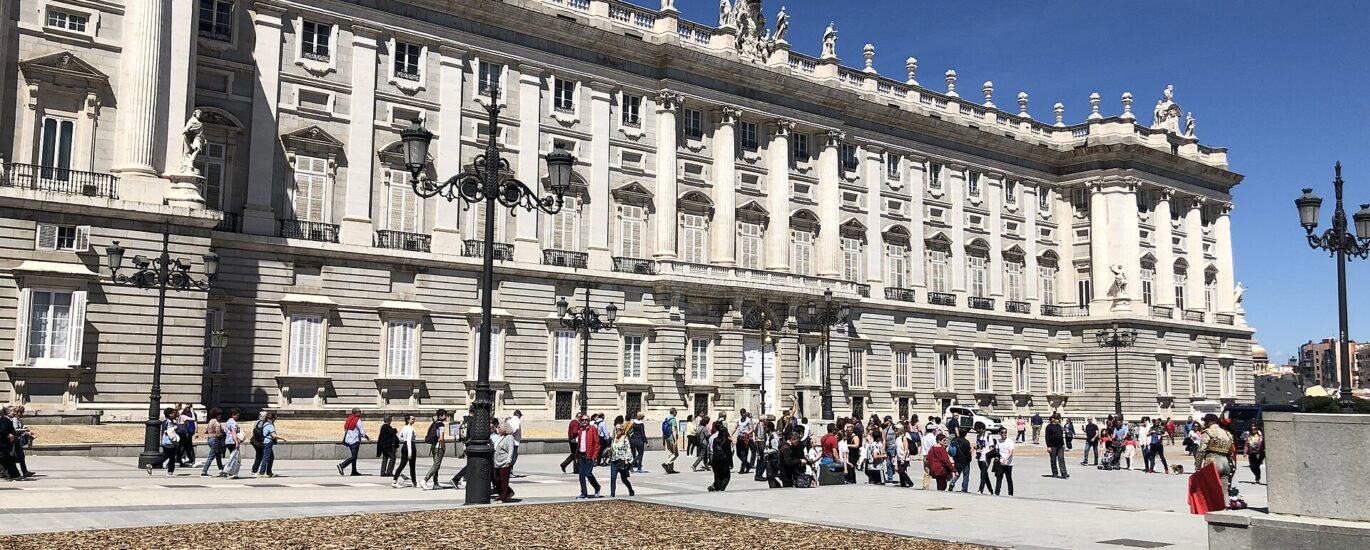
The Royal Palace Madrid is one of the clearest places in Spain to teach the history of the Spanish monarchy. Students walk through state rooms, see royal collections and stand in a square where official ceremonies still take place. For a high school group, it connects European history, art and government in a single visit.
This guide explains the palace’s history in simple terms. It covers the rooms and collections that interest students most and the Changing of the Guard. It also gives practical tips for teachers and nearby sights like Plaza Mayor and Puerta del Sol. At the end, you will see how the palace fits into our 10-day Spain program.
A Short History of the Royal Palace Madrid
Before the palace, a fortress called the Alcázar stood on this site. It burned on Christmas Eve in 1734. The fire lasted four days.
King Philip V ordered a new palace. Construction ran from 1738 to 1755. Several Italian architects shaped the design, including Filippo Juvarra, Giovanni Battista Sacchetti and later Francesco Sabatini. Charles III was the first king to live there, starting in 1764.
The palace is very large. It has 3,418 rooms and about 135,000 square meters of floor space. It is the official residence of the Spanish royal family, but it is used mainly for state ceremonies. The Spanish state owns it, and a public agency called Patrimonio Nacional manages it. The palace is open to visitors except on days with official events.
Classroom Connections
The palace links to several subjects:
- History: The change from the Habsburg to the Bourbon dynasty and the reign of Charles III.
- Government: The role of a constitutional monarchy in Spain today.
- Art: Italian and Spanish painting, tapestries and decorative arts.
- Spanish class: Vocabulary for architecture, royalty and ceremonies.
What Students Can See Inside
A guided route takes groups through the main state rooms. These highlights work well for teenagers.
The Throne Room
The Throne Room dates from 1772, during the reign of Charles III. Its ceiling fresco was painted by the Venetian artist Giovanni Battista Tiepolo. Ask students what message the room’s decoration sends to foreign visitors.
The Royal Armoury
The Royal Armoury holds one of the most important collections of arms and armor in the world. Students can see suits of armor made for kings and their horses. It is a good starting point for discussing technology and power in early modern Europe.
The Royal Pharmacy
The Royal Pharmacy became part of the royal household under Philip II. Its jars and old equipment show how medicine was prepared for the court. Science students often enjoy this stop.
The Stradivarius Instruments
The palace holds instruments made by Antonio Stradivari, including the world’s only complete Stradivarius string quintet. Music students often find this collection a highlight.
The Changing of the Guard and Nearby Sights
Changing of the Guard
The Royal Guard holds a Changing of the Guard outside the Puerta del Príncipe on Calle de Bailén. It takes place on Wednesdays and Saturdays, usually from 11 a.m. to 2 p.m. In July and August, it runs from 10 a.m. to noon because of the heat.
A larger Solemn Changing of the Guard takes place on the first Wednesday of most months, usually at noon, in the Plaza de la Armería. It involves about 400 people and 100 horses in historic uniforms. It does not take place in January, August or September. Both ceremonies can be canceled for official events or bad weather, so check the official schedule before your visit.
Gardens and the Almudena Cathedral
The Sabatini Gardens lie on the north side of the palace. The Campo del Moro gardens lie to the west. Across the Plaza de la Armería stands the Almudena Cathedral. Its outside is neoclassical and its inside is neo-Gothic.
Plaza Mayor and Puerta del Sol
Both squares are a short walk from the palace. Plaza Mayor is an arcaded square with a statue of Philip III. Puerta del Sol holds the Kilometre Zero marker, the starting point of Spain’s radial road network. Pairing these squares with the palace adds more things to do in Madrid and gives students a full picture of the historic center. For wider logistics, see how to plan a trip to Spain.
Tips for Teachers Visiting the Royal Palace
- Book group entry in advance. Confirm entry times and group rules directly with Patrimonio Nacional.
- Brief students on behavior. These are working state rooms. Remind students to keep voices low and follow photo rules.
- Plan around closures. The palace closes to the public on days with official events. Have a backup plan.
- Prepare questions. Give each student one thing to look for, such as a symbol, a portrait or a date.
Before the trip, review Spanish gestures and etiquette with students. For more on the wider route, see our guide to a cultural journey through Spain.
The Royal Palace in Our Spain Program
In the Spain Global Impact Fellowship 2027, the Royal Palace is part of Day 7 in Madrid. Students take a city tour of Plaza Mayor, Puerta del Sol and the Royal Palace. That same day, they join a guided student visit to the Prado Museum. Program transportation, meals and guided visits are included.
FAQ
Who manages the Royal Palace Madrid?
The Spanish state owns the palace. A public agency called Patrimonio Nacional manages it and sets visiting hours and group rules.
When is the Changing of the Guard at the Royal Palace?
The regular ceremony is on Wednesdays and Saturdays, usually from 11 a.m. to 2 p.m. The Solemn Changing of the Guard is on the first Wednesday of most months at noon. Check the official schedule before you go.
Does the Spanish royal family live in the Royal Palace?
The palace is the official residence of the royal family. In practice, it is used mainly for state ceremonies and official events.
Visit Madrid’s Royal Palace with Your Students
The Royal Palace gives students a direct look at Spanish history, art and government. Our Spain Global Impact Fellowship 2027 is a 10-day program in Barcelona and Madrid built for high school groups. Fill out our form to learn more.
Start your journey by downloading the Engaged Education Brochure and learn more about our immersive programs in Spain and beyond. Interested in creating lasting impact around the world? You can directly assist communities in need by becoming a monthly donor through MEDLIFE’s Moving Mountains initiative.