Students can know the grammar and still get lost in a real conversation. A local says something “costs an eye from the face,” and the group looks confused. Spanish idioms are expressions whose meaning differs from the literal words. They appear in everyday speech, and learning a few makes conversations easier to follow.
This guide covers common Spanish idioms that are useful on a school trip. For each one, you will see the literal translation, the real meaning and a short example. You will also find tips for practicing idioms before and during travel, and notes on how usage changes from country to country. At the end, we explain how our programs in Peru and Spain give students daily practice with real conversation.
Why Spanish Idioms Matter for Student Travelers
Idioms carry culture. They show what people joke about, what they value and how they describe daily life. When students understand them, they catch more of what they hear on the street, in markets and with guides.
Idioms also help with listening confidence. A student who recognizes “es pan comido” in a fast conversation feels more included. Over time, using one or two common expressions correctly can make conversations feel more natural.
Usage varies by country and region. An expression common in Madrid may be less common in Lima, and the reverse. The idioms below are widely known, but students should listen for how locals use them. For more on learning through context, read about Spanish immersion through travel.
Common Spanish Phrases for Travel and Everyday Life
Ser pan comido
- Literal: To be eaten bread.
- Meaning: To be very easy.
- Example: “El examen fue pan comido.” The test was a piece of cake.
Meter la pata
- Literal: To put in the paw.
- Meaning: To make a mistake.
- Example: “Metí la pata con la dirección.” I messed up the address.
Echar una mano
- Literal: To throw a hand.
- Meaning: To help someone.
- Example: “¿Me echas una mano con la maleta?” Can you help me with my suitcase?
Costar un ojo de la cara
- Literal: To cost an eye from the face.
- Meaning: To be very expensive.
- Example: “Ese recuerdo cuesta un ojo de la cara.” That souvenir costs an arm and a leg.
En un abrir y cerrar de ojos
- Literal: In an opening and closing of eyes.
- Meaning: Very quickly, in the blink of an eye.
- Example: “El día pasó en un abrir y cerrar de ojos.” The day went by in the blink of an eye.
Spanish Idioms About Feelings and Attitude
Ponerse las pilas
- Literal: To put in the batteries.
- Meaning: To get going or get focused.
- Example: “Tenemos que ponernos las pilas para llegar al tren.” We need to get moving to catch the train.
No pegar ojo
- Literal: Not to stick an eye.
- Meaning: Not to sleep at all.
- Example: “No pegué ojo en el avión.” I didn’t sleep at all on the plane.
No tener pelos en la lengua
- Literal: Not to have hairs on the tongue.
- Meaning: To speak very directly.
- Example: “Mi abuela no tiene pelos en la lengua.” My grandmother says exactly what she thinks.
Tener mala pata
- Literal: To have a bad paw.
- Meaning: To have bad luck.
- Example: “¡Qué mala pata! Perdimos el autobús.” What bad luck! We missed the bus.
Donde comen dos, comen tres
- Literal: Where two eat, three eat.
- Meaning: There is always room for one more.
- Example: Someone might say this when inviting a student to join the table.
How to Practice Common Expressions Before and During a Trip
- Learn a few at a time. Pick three or four idioms per week before departure.
- Use flashcards with examples. Write the idiom, the meaning and a sentence you might actually say on the trip.
- Listen before you use. Notice how guides and locals use expressions in context.
- Keep a trip journal. Each evening, write down one new expression you heard and where you heard it.
- Check tone. Some expressions are casual. Use them with peers and keep polite language with adults you don’t know.
These habits connect well with the benefits of cultural immersion for language learning.
Using Spanish Idioms on Our Programs in Peru and Spain
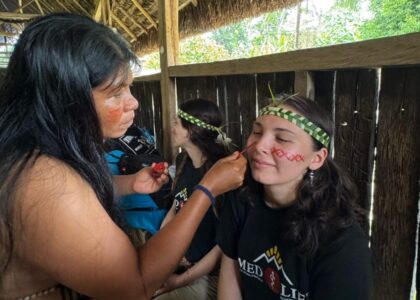
Our 8-day Language Immersion in Lima and Language Immersion in Cusco programs include Spanish lessons, conversational practice and daily activities in Spanish. In Lima, students complete a market challenge, join a cooking class and visit the Barranco art district. In Cusco, they explore the historic center and the Sacred Valley and visit Machu Picchu. In both cities, students visit MEDLIFE partner communities to learn about global health while practicing Spanish.
Our 10-day Spain Global Impact Fellowship 2027 takes place in Barcelona and Madrid. Students join a tapas cooking class at Mescladis, a street art workshop in Lavapiés and a project presentation at the San Cristóbal Market. Learn why immersion programs suit high schoolers.
FAQ
What is the most common Spanish idiom?
There is no single most common idiom. Expressions like “echar una mano” (to help) and “meter la pata” (to make a mistake) are widely used and easy for students to learn.
What does “ser pan comido” mean?
“Ser pan comido” means something is very easy. It is similar to the English expression “a piece of cake.”
Are Spanish idioms the same in Spain and Latin America?
Many idioms are shared, but usage varies by country and region. Some are more common in Spain, and others are more common in parts of Latin America.
Bring Spanish Idioms to Life Abroad
Hearing idioms in real conversations helps students connect classroom Spanish with how people actually talk. Our Language Immersion programs in Lima and Cusco and our Spain Global Impact Fellowship 2027 are designed for high school groups. Fill out our form to learn more.
Start your journey by downloading the Engaged Education Brochure and learn more about our immersive programs in Peru, Spain, and beyond. Interested in creating lasting impact around the world? You can directly assist communities in need by becoming a monthly donor through MEDLIFE’s Moving Mountains initiative.