

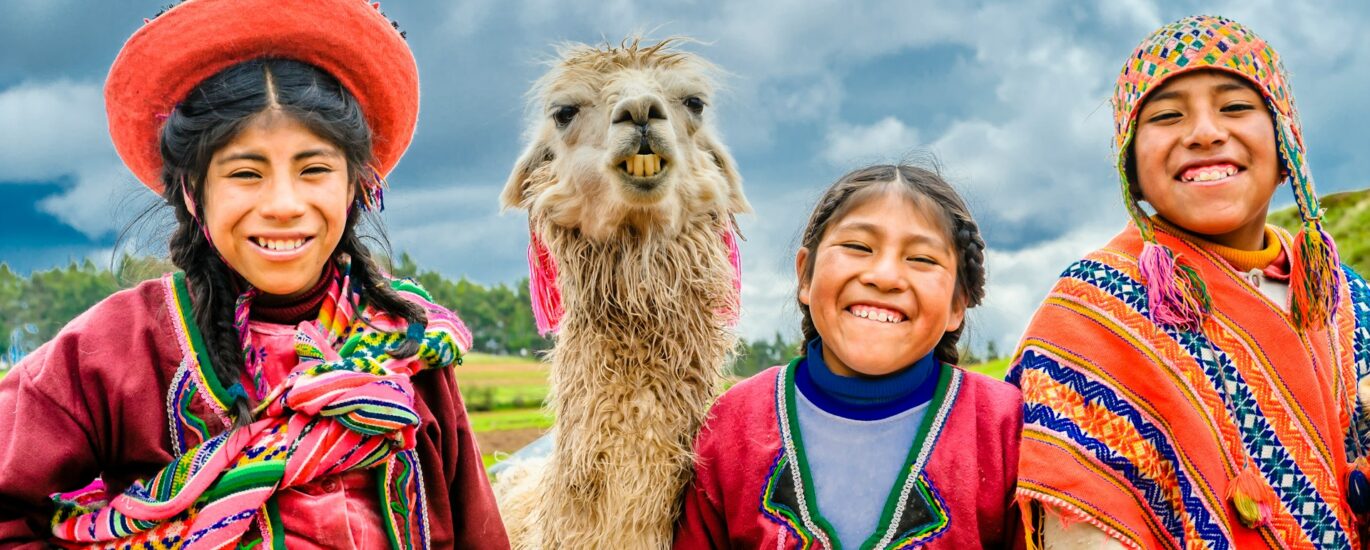
Spanish is the main language most visitors hear in Peru. In Cusco, students will also hear the Quechua language in markets, on buses, and in family conversations. Learning a few words is a respectful way to start a trip and a good lesson in how languages live side by side.
This guide explains where Quechua comes from, who speaks it today, and how it works. It also lists simple Quechua words and phrases students can practice before they travel. Teachers will find ideas for short classroom activities. At the end, we explain how our Cusco program gives students daily Spanish practice in a region where Quechua is part of everyday life.
What Is the Quechua Language?
Quechua is a family of closely related Indigenous languages spoken in the Andes. It was the common language of the Inca Empire, which helped spread it across a large territory. The Cusco variety was spoken by the Inca nobility.
Who speaks Quechua today
Quechua is used in several South American countries, including Peru, Bolivia, Argentina, Chile, and Colombia. Peru’s 2017 census counted about 3.8 million Quechua speakers. That is about 13 percent of the population, according to UNESCO’s World Atlas of Languages.
Its place among indigenous languages in Peru
Peru recognizes Spanish as an official language. The Constitution also gives official status to Quechua, Aymara, and other Indigenous languages in the areas where they predominate. Many people in the Cusco region grow up speaking both Quechua and Spanish. You can read more about bilingual education in Peru on our blog.
How the language works
Quechua builds meaning by adding endings to a root word. Linguists call this an agglutinative language. Here is a simple example with wasi, which means “house”:
- wasi: house
- wasiy: my house
- wasiyki: your house
- wasinchik: our house
- wasicha: little house
Quechua spelling often uses only three vowels: a, i, and u. Spellings also vary between regions and sources. Students should expect small differences when they see words written in Cusco.
Quechua Words Students Can Learn Before the Trip
These greetings and phrases come from Cusco Quechua. Practice them out loud, and do not worry about perfect pronunciation. Local speakers usually appreciate the effort.
Greetings and basic courtesy
- Rimaykullayki: hello (a respectful greeting)
- Allillanchu?: how are you?
- Solpayki: thank you
- Allichu: please
- Arí: yes
- Huq p’unchaykama: see you another day
- Imataq sutiyki?: what is your name?
- Sutiymi…: my name is…
Everyday Quechua words
- Inti: sun
- Killa: moon
- Wasi: house
- Pacha: earth, world, or time
- Papa: potato
- Michi: cat
- Kuntur: condor
Quechua words already in English
Students may know some Quechua without realizing it. Several English words came from Quechua, often through Spanish:
- Llama, the Andean pack animal
- Condor, from kuntur
- Puma, the mountain cat
- Quinoa, from kinua
- Jerky, from ch’arki, meaning dried meat
- Guano, from wanu, meaning fertilizer
Classroom activities
- Create flashcards with Quechua, Spanish, and English side by side.
- Ask students to find Quechua place names on a map of the Cusco region.
- Compare the wasi endings with possessive forms in Spanish and English.
- Discuss why languages borrow words, using the English list above.
Before travel, students should also review easy Spanish phrases. Spanish is the language they will use most during the program.
Practice Language in Context in Cusco
Our Language Immersion in Cusco program is an 8-day trip for high school groups. Students take interactive and conversational Spanish lessons during the week. They then use what they learn in real settings.
On Day 3, students tour Cusco’s historic center and nearby sites such as Sacsayhuaman, Tambomachay, and Puca Pucara. Many place names they see come from Quechua, which makes a good discussion point. That evening, the group attends a performance at the Centro Qosqo de Arte Nativo. On Day 4, students visit MEDLIFE partner communities to learn about global health while practicing Spanish.
On Day 5 in the Sacred Valley, students visit the Pisac archaeological site and the Sounds of the Andes Interpretation Center in Cuyo Chico. There, they learn about clay instruments and take part in a ceramic workshop. Day 6 includes a guided visit to Machu Picchu. Teachers can read how the program supports educators in our guide to language immersion in Cusco.
A note on respect: students should ask before taking photos of people. A friendly greeting in Quechua or Spanish is a good way to start that conversation.
FAQ
Is Quechua still spoken in Peru?
Yes. Peru’s 2017 census counted about 3.8 million Quechua speakers. It is widely spoken in Andean regions such as Cusco.
How do you say thank you in Quechua?
In Cusco Quechua, “thank you” is often written solpayki or sulpayki. Spellings vary by region and source.
What English words come from Quechua?
Llama, condor, puma, quinoa, jerky, and guano all come from Quechua. Most of them entered English through Spanish.
Learn Spanish Where Quechua Is Part of Daily Life
A few Quechua words help students connect with the people and places they meet in Cusco. Our Language Immersion in Cusco program builds on that curiosity with daily Spanish lessons, Inca sites, and community visits. Our Language Immersion in Lima program offers a coastal option. Fill out our form to learn more.
Start your journey by downloading the Engaged Education Brochure and learn more about our immersive programs in Peru, Spain, and beyond. Interested in creating lasting impact around the world? You can directly assist communities in need by becoming a monthly donor through MEDLIFE’s Moving Mountains initiative.