
The Pisac market is a popular stop in Peru’s Sacred Valley. It sits in a small town at the eastern end of the valley. High above the plaza, a large Inca complex spreads across the mountainside. Together, the town and the ruins give students a full day of history, culture, and real Spanish practice.
This guide explains what students should know before they go. You will learn how the market works, what sellers offer, and how students can use their Spanish respectfully. We also cover the history of the Pisac ruins and the main areas to see. Finally, we share tips for teachers and explain how Pisac fits into our Cusco language immersion program.
What to know about the Pisac market
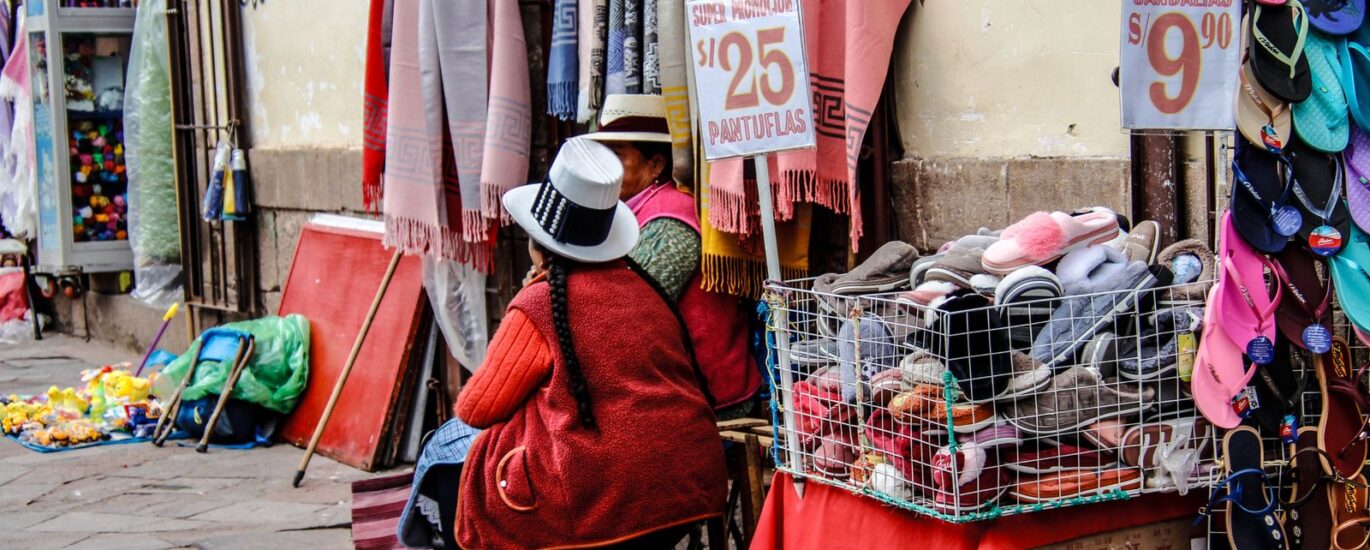
The market fills Pisac’s central plaza and the streets around it. According to Fodor’s, it runs every day and grows larger on Tuesdays, Thursdays, and Sundays. Stalls usually open in the morning and close in the late afternoon.
What students will find
Craft stalls fill the plaza. Students will see textiles, ceramics, and jewelry. Food and produce sellers often set up on the side streets. Look for fruits, vegetables, and grains. These stalls are a good place to talk about Andean farming and the crops the Inca grew in the Sacred Valley.
On Sundays, a Mass in Quechua is held in the town church. Quechua is still widely spoken in the region. Hearing it helps students understand that Peru is a multilingual country.
Practicing Spanish at the market
Markets are one of the easiest places to practice Spanish. Students can greet sellers, ask prices, and ask how an item was made. Some useful phrases:
- Buenos días. ¿Cuánto cuesta? (Good morning. How much is it?)
- ¿Quién lo hizo? (Who made it?)
- ¿De qué material es? (What material is it?)
- Gracias, muy amable. (Thank you, very kind.)
Our list of easy Spanish phrases is a good pre-trip review.
Shopping with respect
Bargaining is common in Andean markets. Students should keep it friendly and accept a fair price. Fodor’s also notes that not every stall sells its own work. Students who want to support local artisans can ask who made an item.
The Pisac ruins: Inca history above the town
The Pisac ruins sit on a ridge above the town, between two small rivers that flow into the Urubamba. Most archaeologists credit the complex to the Inca ruler Pachacuti, around 1450. The site includes residential areas, ceremonial spaces, and farmland.
The terraces
The most striking feature is the system of agricultural terraces. There are around 500 of them, stepping up the hillside. The Inca used terraces to create flat farmland, manage water, and reduce erosion. From the top, students can see how the whole slope was shaped for farming.
The Intiwatana sector
The ceremonial heart of the site is called the Intiwatana. It includes fine Inca stonework and a carved ritual rock that may have tracked the sun. The rock was damaged during the colonial period and again by vandals in modern times. That sector is currently closed to visitors.
The cliff cemetery
Across a gorge, students can see a cliff face dotted with holes. These are Inca tombs. Estimates of their number range from about 3,500 to as many as 10,000. Most were looted long ago.
From Inca site to colonial town
In the 1570s, the Spanish viceroy Francisco de Toledo founded the modern town of Pisac in the valley below. That is why the market and the ruins sit at different levels today.
Tips for teachers visiting Pisac
- Prepare for altitude and stairs. Parts of the ruins sit above 3,400 meters. Paths are steep and uneven.
- Pack for sun. Bring sunscreen, a hat, water, and a light layer.
- Set clear market rules. Agree on meeting points, buddy pairs, and a time limit before students enter the market.
- Keep valuables secure. Crowded markets call for zipped bags and small amounts of cash.
- Check site tickets. The Pisac ruins are included in the Cusco tourist ticket. Confirm current rules before you go.
For a broader cultural context, see our article on the indigenous culture of Peru. Students who enjoy the produce stalls may also like our list of Peruvian food to try.
Pisac on our Cusco program
Our Language Immersion in Cusco program is an 8-day trip for high school groups. Pisac is part of Day 5, which takes place in the Sacred Valley.
The day starts with a Spanish lesson. Students then visit the Pisac archaeological site. After that, the group goes to the Sounds of the Andes Interpretation Center in Cuyo Chico for a ceramic workshop and an introduction to Andean clay instruments. The program summary also lists a Pisac Market Challenge, an activity where students put their Spanish to work at the market. The group stays overnight in the Sacred Valley before the train to Machu Picchu on Day 6.
Entrance fees, local guides, and an expert tour conductor are included.
FAQ
What days is the Pisac market open?
The Pisac market runs every day. It is usually larger on Tuesdays, Thursdays, and Sundays.
Who built the Pisac ruins?
The Inca built the Pisac complex. Most archaeologists credit the ruler Pachacuti, around 1450.
Can students practice Spanish at the Pisac market?
Yes. Sellers speak Spanish, and many also speak Quechua. Students can practice greetings, prices, and questions about crafts and food.
Visit Pisac with your students
Pisac lets students move from an Inca hillside to a working Andean market in one day. Our Language Immersion in Cusco program includes Pisac, the Sacred Valley, and Machu Picchu. Fill out our form to learn more.
Start your journey by downloading the Engaged Education Brochure and learn more about our immersive programs in Peru, Spain, and beyond. Interested in creating lasting impact around the world? You can directly assist communities in need by becoming a monthly donor through MEDLIFE’s Moving Mountains initiative.