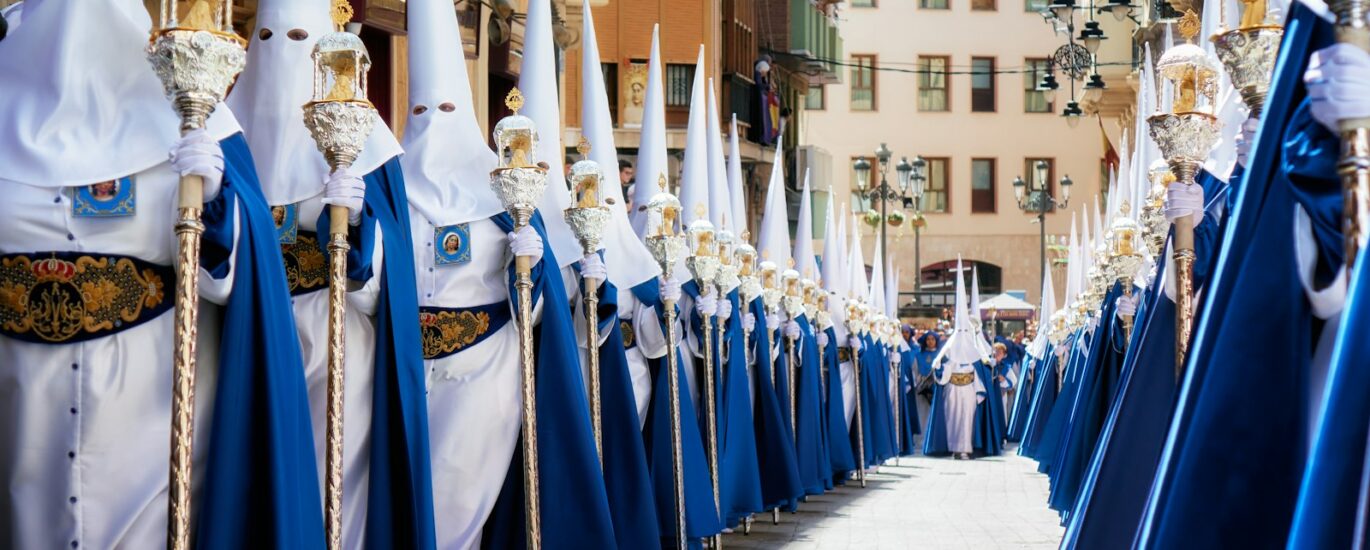
Holy Week is one of the most important religious and cultural traditions in the country. Semana Santa in Spain fills city streets with processions, music and centuries-old sculptures. For many Spanish families, it is a time of faith, memory and community. For students, it is a window into how religion, art and local identity connect.
This guide explains what Semana Santa is and how it is celebrated in different regions. You will learn key vocabulary, the roles people play in processions and the foods linked to the week. We also share tips on respectful behavior and classroom discussion. Teachers can use it to prepare a lesson or to help students understand religious heritage they will see in Spain at any time of year.
What Is Semana Santa in Spain?
Semana Santa means “Holy Week.” It runs from Palm Sunday to Easter Sunday and marks the last days of the life of Jesus in the Christian tradition. The dates change each year because they follow the date of Easter. In 2027, Holy Week runs from March 21 to March 28.
The best-known events are the processions. Catholic brotherhoods, called “cofradías” or “hermandades,” organize them. Membership often passes through families for generations.
Key Vocabulary for Students
- Paso: A float carrying a sculpture of a scene from the Passion or of the Virgin Mary. Some brotherhoods have cared for their pasos for centuries.
- Costalero: A person who carries the paso from underneath. In Seville, between 24 and 48 costaleros may carry a single float.
- Nazareno: A participant who wears a long robe and a tall pointed hood.
- Capirote: The pointed hood. It comes from medieval penitential practice and allowed penitents to stay anonymous.
- Saeta: A short, emotional song in flamenco style sung to a passing paso, often from a balcony.
The capirote may look unfamiliar to students from the U.S. and Canada. Explain its religious origin before showing images, so students understand what it means in Spain.
Holy Week Traditions Across Spain
Holy Week looks different from one region to another. Comparing them shows students that Spain has many local cultures.
Andalusia
Andalusia is known for large, emotional processions. Seville has celebrated Semana Santa since the 16th century. According to Spain’s official tourism site, 71 brotherhoods take part there, with about 50,000 nazarenos. The most important moment is “La Madrugá,” the night between Holy Thursday and Good Friday. Málaga and Granada also hold major celebrations.
Castilla y León
In cities such as Valladolid, Zamora, León and Salamanca, processions are known for their silence and solemn tone. These cities are a useful contrast with Andalusia in a class discussion.
National Recognition
Spain gives some festivals the title “Fiesta of International Tourist Interest.” Holy Week celebrations in several cities hold it, including Seville, Málaga, Valladolid and Zamora.
Food Traditions
- Torrijas: Bread soaked in milk, coated in egg, fried in olive oil and finished with sugar or cinnamon.
- Potaje de vigilia: A stew of chickpeas, spinach and salt cod, traditionally eaten on Good Friday, when many Catholics avoid meat.
- Mona de Pascua: An Easter cake from Catalonia and parts of eastern Spain. Godparents often give one to their godchildren on Easter Monday.
Teaching Holy Week Respectfully
Semana Santa is a living religious practice. Students of every background can learn from it when it is presented with care.
Classroom Tips
- Describe traditions factually and avoid judging beliefs.
- Invite students to share traditions from their own families, religious or not.
- Use vocabulary in context, such as “El paso sale de la iglesia.”
- Compare regional styles using photos and videos from official tourism sources.
These conversations support cross-cultural learning for teens and help students build empathy.
Etiquette for Visitors
Groups who visit Spain during Holy Week should prepare students carefully. Large crowds are common, and some streets close. Students should stay quiet during solemn moments, avoid crossing through a procession and ask before photographing individuals. Leaders should check official city information for routes and closures. Our guide to a responsible student travel itinerary covers more planning principles.
Religious Heritage on Our Spain Program
The itinerary of our 10-day Spain program in Barcelona and Madrid does not include Holy Week events. Students still meet Spain’s religious and artistic heritage at several stops.
In Barcelona, they visit the Sagrada Familia, Antoni Gaudí’s basilica. They take a train to Montserrat, ride the cogwheel train to the monastery and visit its Basilica. In Madrid, a guided student visit to the Prado Museum introduces many religious works by Spanish masters. These visits give context to the traditions students study in class. Learn more in our article on a cultural journey through Spain.
FAQ
What is Semana Santa in Spain?
Semana Santa is Holy Week, the week from Palm Sunday to Easter Sunday. In Spain, Catholic brotherhoods mark it with processions that carry religious sculptures through the streets.
Why do people in Semana Santa processions wear pointed hoods?
The pointed hood, called a capirote, comes from medieval penitential practice. It allowed penitents to take part while staying anonymous.
Where is Semana Santa celebrated in Spain?
It is celebrated across Spain. Seville, Málaga and Granada are known for large processions, while Valladolid and Zamora are known for solemn ones.
Explore Spain’s Cultural Heritage With Your Students
Studying Semana Santa helps students understand faith, art and community in Spain. Our Spain Global Impact Fellowship 2027 is a 10-day program in Barcelona and Madrid built for high school groups. Fill out our form to learn more.
Start your journey by downloading the Engaged Education Brochure and learn more about our immersive programs in Spain and beyond. Interested in creating lasting impact around the world? You can directly assist communities in need by becoming a monthly donor through MEDLIFE’s Moving Mountains initiative.