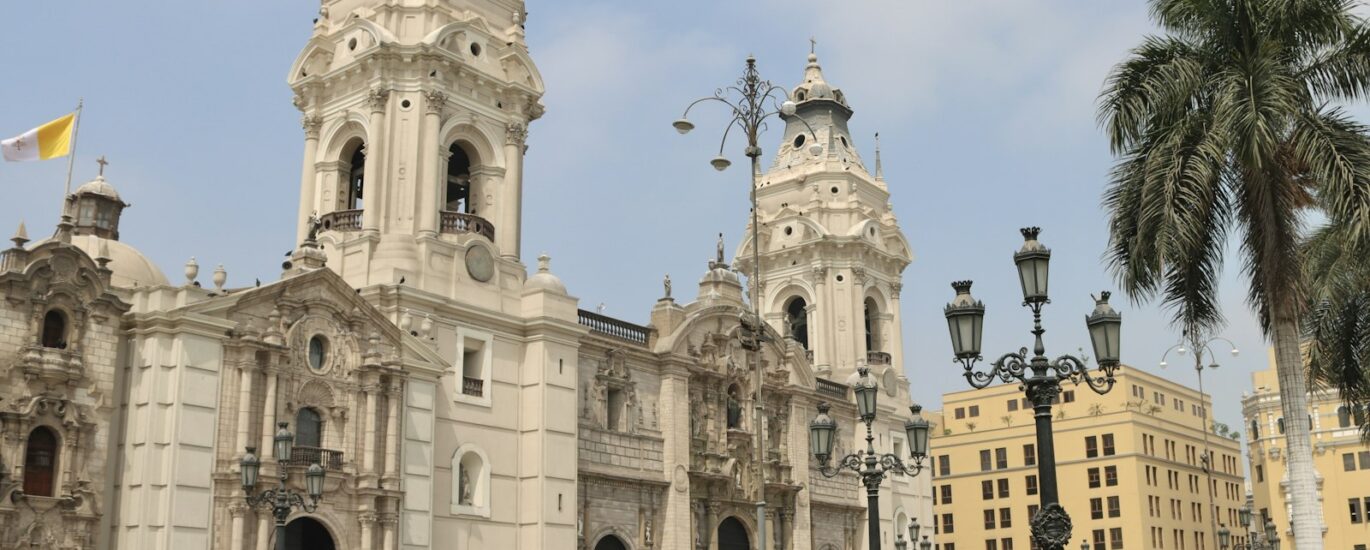
Every city has a starting point. In Lima, it is the Plaza Mayor, and the Lima Cathedral stands on its east side. The Spanish founded the city here in 1535. Nearly five centuries later, the square is still the center of civic and religious life in Peru’s capital.
This guide is written for teachers, students and parents preparing for a trip to Lima. You will learn the key history of the Plaza Mayor and the cathedral. You will also see which buildings surround the square and why the area is a UNESCO World Heritage site. At the end, we share practical tips for groups, a short FAQ and how our Lima program explores the historic center.
The Plaza Mayor of Lima: Where the City Began
Francisco Pizarro founded Lima on January 18, 1535. He called it “La Ciudad de los Reyes,” or the City of Kings. On that same day, he marked out the location of the main square. Locals call it both the Plaza Mayor and the Plaza de Armas.
The square follows the Spanish colonial grid. Streets run out from it in straight lines. This layout was repeated in many cities across the Americas, so students can recognize it later in other places.
The Fountain at the Center
The first fountain on the square was inaugurated in 1578. The one that stands there today replaced it and was inaugurated in 1651. Students can use it as an easy meeting landmark.
Buildings Around the Square
Several important buildings face the plaza:
- Government Palace: The official seat of Peru’s president. Pizarro built his home on this site. The current building was mostly built between 1926 and 1938. A changing of the guard takes place around midday, so check the current schedule locally.
- Archbishop’s Palace: A neo-colonial building from 1924, designed by architect Ricardo de Jaxa Malachowski. It stands next to the cathedral.
- Lima Cathedral: The main church of the city, described below.
Lima Cathedral: History and Architecture
Construction of the first church on the site began in 1535, the year the city was founded. Lima became the seat of a diocese in 1541, and the church was designated a cathedral. In 1547, Lima was raised to an archdiocese.
Rebuilt After Earthquakes
Lima sits in an active seismic zone. Earthquakes damaged the cathedral several times. Major rebuilding followed the earthquakes of 1687 and 1746, and the building was restored again in 1940. What students see today is the result of these phases. This history makes the cathedral a good case study for how colonial cities adapted to natural hazards.
Pizarro’s Tomb and the Wooden Choir
The cathedral holds the tomb of Francisco Pizarro. In the 1980s, researchers analyzed the remains and concluded they belonged to him. Inside, students can also look for the carved wooden choir stalls attributed to the Spanish sculptor Pedro de Noguera. Opening hours and entry rules can change, so confirm them before your visit.
The Historic Center of Lima as a Classroom
UNESCO added the Historic Centre of Lima to its World Heritage List in 1988 and extended the listing in 1991. The listing recognizes the area’s colonial architecture and urban layout.
For teachers, the plaza connects to many subjects:
- History: colonial rule, independence and modern government, all visible on one square.
- Spanish: reading plaques, asking for directions and describing buildings.
- Art and architecture: colonial facades, church interiors and urban design.
- Civics: how public squares are used for ceremonies and public gatherings.
A useful activity is a short observation task. Ask students to note who uses the square, how it is used and which buildings represent which institutions. Then discuss the findings in Spanish.
Safety Tips for Groups
The historic center is busy, especially at midday and on weekends. Keep the group together and agree on a meeting point. Students should carry only what they need and keep phones and wallets secure. Follow the guidance of your group leader on which streets to use. For more advice, see our Peru travel safety tips.
Exploring Historic Lima on Our Language Immersion Program
Our 8-day Language Immersion in Lima program includes a day dedicated to the historic center. On Day 4, students explore historic Lima with museum visits and the Lugar de la Memoria (LUM), a site focused on Peru’s recent history. An optional evening visit to the Magic Water Circuit is also available.
The rest of the week combines Spanish lessons with real practice. Students take part in a market challenge and a cooking class, visit the Barranco art district and join an Afro-Peruvian music and dance workshop. They also visit MEDLIFE partner communities to learn about global health while practicing Spanish. An expert tour conductor travels with the group. Read our Peru language immersion guide for more details. Teachers can also explore teacher immersion programs in Lima.
FAQ
Who is buried in the Lima Cathedral?
Francisco Pizarro, the Spanish conquistador who founded Lima in 1535, is buried in the Lima Cathedral. Researchers analyzed his remains in the 1980s and confirmed their identity.
Is the Plaza Mayor the same as the Plaza de Armas in Lima?
Yes. Both names refer to Lima’s main square. It is surrounded by the Lima Cathedral, the Archbishop’s Palace and the Government Palace.
Why is the historic center of Lima a UNESCO site?
UNESCO listed the Historic Centre of Lima in 1988 and extended it in 1991. It recognizes the area’s colonial architecture and city layout.
Bring Your Students to Historic Lima
Lima’s main square lets students see five centuries of history in one place, then practice Spanish in the streets around it. Our Language Immersion in Lima program is an 8-day experience built for high school groups. Fill out our form to learn more.
Start your journey by downloading the Engaged Education Brochure and learn more about our immersive programs in Peru, Spain, and beyond. Interested in creating lasting impact around the world? You can directly assist communities in need by becoming a monthly donor through MEDLIFE’s Moving Mountains initiative.