
Few works of art carry as much history as the Guernica painting. Pablo Picasso created it in 1937, weeks after the bombing of a small Basque town during the Spanish Civil War. Today it is one of the most studied images of the 20th century. It appears in art, history, Spanish and social studies classrooms across North America.
This guide gives teachers the key facts behind Guernica. It covers the historical context, how Picasso made the painting and the long route it took to reach Madrid. You will also find symbols to discuss, lesson ideas and a note on how Spain’s art museums can connect to a student trip. Use it to plan a single lesson or a short cross-curricular unit.
The History Behind the Guernica Painting
The Spanish Civil War
The Spanish Civil War lasted from 1936 to 1939. It divided the country between the Republicans, who defended the elected government, and the Nationalists, led by General Francisco Franco. Nazi Germany and Fascist Italy sent troops, tanks and planes to support the Nationalists.
The Bombing of Guernica
On April 26, 1937, German and Italian aircraft bombed Guernica, a town in the Basque Country, at the request of the Nationalists. The Reina Sofía Museum identifies the attackers as the Condor Legion, a unit of the Nazi air force.
How Picasso Created Guernica
Picasso was born in Málaga, Spain, in 1881 and lived in France for much of his adult life. In 1937, the government of the Spanish Republic asked him to create a work for its pavilion at the International Exposition in Paris. After the bombing, he chose Guernica as his subject.
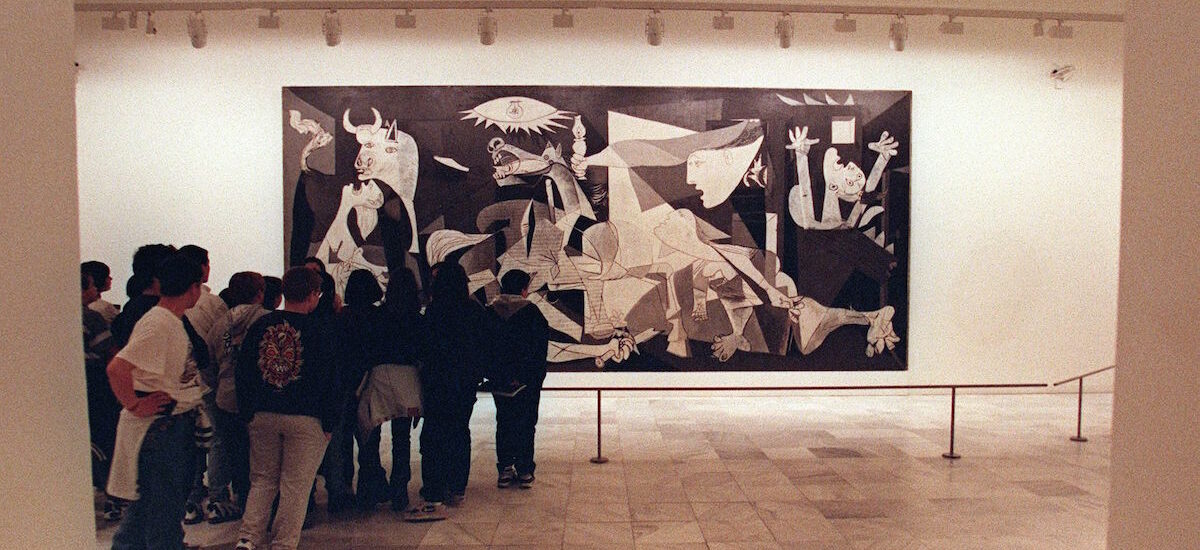
He painted the work in Paris between May 1 and June 4, 1937. It is an oil painting on canvas measuring about 3.5 meters tall and 7.8 meters wide. Picasso used only black, white and gray, a monochrome technique called grisaille. Ask students how the lack of color changes the mood.
Guernica’s Journey to Madrid
After the exposition, the painting toured abroad. During World War II, Picasso placed it at the Museum of Modern Art in New York for safekeeping. He later said it should return to Spain only when democracy was restored. Guernica arrived in Spain in 1981, eight years after Picasso’s death. It was first shown at the Casón del Buen Retiro, an annex of the Prado Museum. In 1992 it moved to the Museo Nacional Centro de Arte Reina Sofía in Madrid, where it hangs today.
Teaching Picasso Facts and Symbols in Class
Guernica has no single “correct” reading. Picasso gave few explanations, which makes the painting a strong prompt for discussion.
Figures to Look For
- The bull on the left side of the canvas.
- The horse at the center, wounded and screaming.
- The mother holding a lifeless child.
- The light bulb shining above the horse.
- The fallen rider lying beneath the horse.
Ask students what each figure might represent. Then share how art historians have interpreted them. Compare interpretations and discuss why they differ.
Lesson Ideas
- Art: Students create a black-and-white response piece about an event they have studied.
- History: Pair the painting with primary sources about the Spanish Civil War. Discuss how art can shape public memory.
- Spanish: Students describe the painting in Spanish using emotion and color vocabulary.
- Cross-curricular: Compare Guernica with Francisco de Goya’s “The Third of May 1808,” painted in 1814 and held at the Prado. Both works show violence against civilians.
The images in Guernica are disturbing. Prepare students before viewing, and give them space to respond in their own way.
These lessons connect well with travel-based learning. Our article on travel in the curriculum explains how teachers link trips to course goals.
Spanish Art on Our Spain Program
Guernica hangs at the Reina Sofía Museum. Our Spain program does not visit the Reina Sofía. It does include a guided student visit to the Prado Museum in Madrid, home of major works by Goya and Velázquez. Students who have studied Guernica can explore the Spanish painting tradition that came before it. The visit gives useful context for the Goya comparison above.
The 10-day program also includes a Lavapiés street art tour and workshop in Madrid. Students see how artists use public walls to respond to their communities. In Barcelona, they visit Antoni Gaudí’s Sagrada Familia and Park Güell. For an overview of the full trip, read about our educational tours to Spain. After returning, use our tips on student travel reflection to connect what students saw with classroom work.
FAQ
What is the Guernica painting about?
Guernica shows the suffering caused by the 1937 bombing of Guernica, a Basque town, during the Spanish Civil War. Picasso painted it for the Spanish Republic’s pavilion at the 1937 Paris International Exposition.
Where is Picasso’s Guernica today?
Guernica is at the Museo Nacional Centro de Arte Reina Sofía in Madrid. It has been there since 1992.
Why is Guernica black and white?
Picasso painted Guernica in black, white and gray using a monochrome technique called grisaille. Picasso explained little about his choices, so the effect of the palette is a common topic for class discussion.
Explore Spanish Art and History With Your Students
Guernica gives students a powerful entry point into Spanish history and art. Our Spain Global Impact Fellowship 2027 is a 10-day program in Barcelona and Madrid built for high school groups. Fill out our form to learn more.
Start your journey by downloading the Engaged Education Brochure and learn more about our immersive programs in Spain and beyond. Interested in creating lasting impact around the world? You can directly assist communities in need by becoming a monthly donor through MEDLIFE’s Moving Mountains initiative.