Ollantaytambo is a small town at the western end of Peru’s Sacred Valley. Many travelers know it as the place where they catch the train to Machu Picchu. The town also has a long history of its own. Its streets follow an Inca layout, and a massive temple complex rises above the main square.
This guide explains what students should know before they arrive. You will learn how Ollantaytambo became an Inca royal estate and why it matters in the story of the Spanish conquest. We also cover its main archaeological sites and practical tips for school groups. Finally, we explain how the town fits into our Cusco language immersion program.
Ollantaytambo history: from royal estate to Inca stronghold
Ollantaytambo sits at about 2,792 meters above sea level. It lies roughly 72 kilometers northwest of Cusco by road. The town stands near the point where the Patacancha River meets the Urubamba River.
A royal estate of Pachacuti
In the 15th century, the Inca ruler Pachacuti conquered the area. He rebuilt the town as one of his royal estates. Inca nobles lived there. Workers farmed the terraces that still line the valley slopes. After Pachacuti’s death, his family lineage managed the estate.
A site of Inca resistance
Ollantaytambo also played a key role during the Spanish conquest. In 1536, the Inca leader Manco Inca led a siege of Cusco. After that siege ended, his forces withdrew to Ollantaytambo. In 1537, a Spanish expedition marched on the town. Manco’s army defeated it on the plain below. Inca fighters attacked from the high terraces and flooded the plain to block the advance. It was a notable Inca victory during the conquest. Manco later moved deeper into the mountains, to Vilcabamba.
What to see in Ollantaytambo
The town is compact and easy to explore on foot. Students can see Inca engineering at three scales: a temple, a town plan, and a farming system.
The Temple Hill
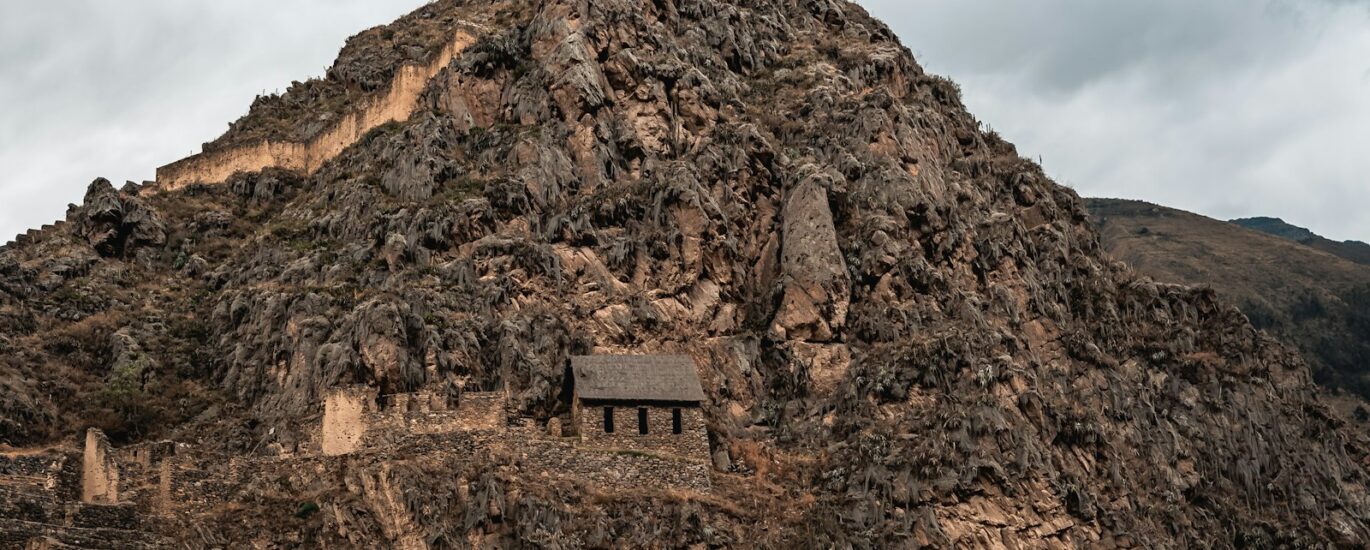
The main archaeological site climbs a hill called Cerro Bandolista. Long rows of terraces lead up to the ceremonial area. At the top stands the unfinished Sun Temple. Its best-known feature is the Wall of the Six Monoliths, made of huge, closely fitted stones.
The stone came from the Kachiqhata quarries on the far side of the Urubamba River. Moving these blocks across the valley was a major engineering task. It is a good discussion point for physics or history classes.
The Inca town
The old part of Ollantaytambo keeps much of its Inca street grid. Several blocks contain kanchas, walled compounds with rooms arranged around a central courtyard. Some dwellings are among the oldest continuously inhabited buildings in South America. Later construction changed parts of the town, so not everything is original. Even so, walking these streets gives students a strong sense of how an Inca town was organized.
The storehouses
On the hills facing the town, students can spot stone storehouses called qollqas. The Inca built them high up, where wind and cool air helped preserve grain and other food. Windows on the uphill and downhill sides helped with loading and ventilation.
Tips for visiting Ollantaytambo as a student group
- Prepare for stairs. The Temple Hill involves many steep steps. Students should wear sturdy shoes and carry water.
- Mind the altitude. Ollantaytambo is lower than Cusco, but it is still high. Students should pace themselves on climbs.
- Bring sun protection. The Andean sun is strong, even on cloudy days. Pack sunscreen, a hat, and sunglasses.
- Watch the traffic. The streets are narrow, and vehicles share them with pedestrians. Leaders should keep groups together near the main square and train station.
- Practice Spanish. Shops, cafés, and market stalls are good places for short, real conversations.
For broader guidance, see our Peru travel safety tips. Entry to the Ollantaytambo archaeological site is part of the Cusco tourist ticket, the Boleto Turístico. Ticket rules and opening hours can change, so check current information before you go.
Ollantaytambo on our Cusco program
Our Language Immersion in Cusco program is an 8-day trip for high school groups. It combines Spanish lessons with visits to Inca sites in Cusco and the Sacred Valley.
On Day 5, the group spends the day in the Sacred Valley. Students have a Spanish lesson, visit the Pisac archaeological site, and take a ceramic workshop at the Sounds of the Andes Interpretation Center in Cuyo Chico. The group stays overnight in the valley. On Day 6, students take the train to Aguas Calientes for a guided visit to Machu Picchu. That evening, the group takes the train back to Ollantaytambo.
That return trip brings students through Ollantaytambo at the end of a long day. A short pre-trip lesson on the town helps them recognize where they are. Train and bus tickets to Machu Picchu are included, along with local guides and an expert tour conductor. Teachers curious about the program from an educator’s angle can read about our immersion programs in Cusco.
FAQ
What is Ollantaytambo known for?
Ollantaytambo is known for its Inca temple complex, its preserved Inca street grid, and its train station for Machu Picchu. It was also the site of an Inca victory over Spanish forces in 1537.
How high is Ollantaytambo?
Ollantaytambo sits at about 2,792 meters (9,160 feet) above sea level. That is lower than Cusco, which is about 3,400 meters.
Is Ollantaytambo part of the Sacred Valley?
Yes. Ollantaytambo is at the western end of the Sacred Valley, along the Urubamba River. Pisac sits near the eastern end.
Explore the Sacred Valley with your students
Ollantaytambo shows students how the Inca planned towns, farmed steep land, and resisted the Spanish. Our Language Immersion in Cusco program brings groups through the Sacred Valley on the way to and from Machu Picchu. Fill out our form to learn more.
Start your journey by downloading the Engaged Education Brochure and learn more about our immersive programs in Peru, Spain, and beyond. Interested in creating lasting impact around the world? You can directly assist communities in need by becoming a monthly donor through MEDLIFE’s Moving Mountains initiative.