Reading is one of the fastest ways to grow vocabulary and grammar in a new language. Yet many students freeze when they see a full page of Spanish. Good Spanish reading comprehension is a skill that can be taught. With the right strategies and texts at the right level, students learn to understand more than they expected, even when they don’t know every word.
This guide shares practical strategies for teaching Spanish reading comprehension before, during and after reading. You’ll find text ideas for each level, from beginner signs and menus to news articles and short stories. You’ll also find classroom activities and tips for using authentic materials. We end with how travel turns reading into a real-world skill, since students read signs, menus and maps all day abroad.
Why reading matters for language learners
- Vocabulary growth: Students meet new words in context, which helps them remember.
- Grammar in action: Reading shows how structures work in real sentences.
- Input at the learner’s pace: Unlike listening, reading lets students slow down and reread.
- Confidence: Understanding a real text gives students a sense of progress.
Our guide to comprehensible input explains why understandable texts help acquisition.
Strategies for Spanish reading comprehension
Before reading
- Preview the text. Look at the title, images, headings and length.
- Activate background knowledge. Ask what students already know about the topic.
- Predict. Students guess what the text will say.
- Pre-teach a few key words. Choose words that are essential to the main idea.
During reading
- Read for the gist first. Students read once without stopping to understand the main idea.
- Use cognates. Words like información or importante are easy to recognize.
- Use context clues. Look at surrounding words and images to guess meaning.
- Skim and scan. Skim for the main idea and scan for specific details, like dates or names.
- Mark the text. Underline unknown words, circle key ideas and add question marks.
After reading
- Summarize. Students explain the main idea in one or two sentences.
- Answer questions. Use a mix of literal and interpretive questions.
- Discuss. What did the author want to say? Do students agree?
- Reuse vocabulary. Students use new words in their own sentences.
Texts for each level
Beginners
- Signs, menus, schedules and ads
- Short social media posts
- Picture books and graded readers
Intermediate
- Short news articles written for learners
- Simple blogs and travel guides
- Comics and short stories
Advanced
- Newspaper articles and opinion pieces
- Short stories and poems by Spanish and Latin American writers
- Texts used on AP Spanish exams
Our post on AP Spanish and travel discusses interpretive reading on the exam.
Classroom activities
- Menu challenge: Give students a real menu from Peru or Spain. They plan a meal within a budget.
- Sign scavenger hunt: Show photos of public signs. Students explain each one.
- Jigsaw reading: Each group reads one section of a text and teaches it to others.
- True or false: Students correct false statements about a text.
- Headline match: Students match news headlines with short articles.
- Reading journal: Students log what they read each week and note new words.
For listening practice that pairs well with reading, see our list of Spanish podcasts for students.
Tips for teachers
- Choose interesting topics. Students read more when they care about the subject.
- Keep it at the right level. Students should understand most of the text.
- Use authentic materials carefully. Real texts are motivating, but simplify the task for beginners.
- Build reading time into class. Short, regular reading sessions add up.
- Offer choice. Let students pick from several texts on a theme so each reader finds something that fits their interests and level.
Reading Spanish on a real trip
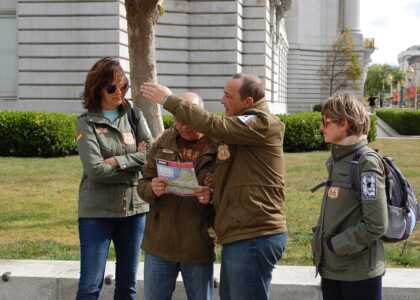
Travel turns reading into a daily necessity. Students read street signs, menus, museum labels, maps and schedules. On Engaged Education’s 8-day Lima and Cusco language immersion programs, students take Spanish lessons and then read real menus and market labels during market challenges and cooking classes. On the 10-day Spain Global Impact Fellowship, they read signs in Spanish and Catalan in Barcelona, train boards on the trip to Madrid and labels at the Prado Museum.
FAQ
How can students improve Spanish reading comprehension?
Students can preview texts, read for the main idea first, use cognates and context clues, and summarize what they read.
What should beginners read in Spanish?
Beginners can start with signs, menus, schedules, short posts, picture books and graded readers.
Do students need to understand every word?
No. Good readers focus on the main idea and use context to guess unknown words.
Read the world in Spanish
Strong reading skills help students navigate real places with confidence. Explore our Language Immersion programs in Lima and Cusco and our Spain Global Impact Fellowship 2027. Fill out our form to learn more.
Start your journey by downloading the Engaged Education Brochure and learn more about our immersive programs in Peru, Spain, and beyond. Interested in creating lasting impact around the world? You can directly assist communities in need by becoming a monthly donor through MEDLIFE’s Moving Mountains initiative.