Many Spanish learners say Peruvian Spanish is one of the easiest accents to understand. Speakers in Lima often pronounce words clearly and at a steady pace. Peruvian Spanish is not uniform, though. The Spanish of the coast differs from the Spanish of the Andes, and centuries of contact with Quechua have shaped vocabulary and expressions across the country.
This guide explains the main features of Peruvian Spanish, from pronunciation and grammar to everyday words borrowed from Quechua. You’ll learn how coastal and Andean Spanish differ and which expressions students are likely to hear in Lima and Cusco. You’ll also find classroom activities that prepare students to listen and speak with confidence on a language immersion trip to Peru.
Pronunciation in Peruvian Spanish
Clear consonants
In Lima and much of Peru, speakers usually pronounce the s at the end of syllables. Los amigos sounds close to how it is written. This makes Peruvian Spanish easier to follow than some Caribbean or southern Spanish accents.
Seseo
Like most of Latin America, Peruvians pronounce z and c before e or i as an s. Gracias sounds like “GRA-see-as.” Speakers in central Spain use a “th” sound for the same letters.
Steady rhythm
Many learners notice that Peruvians, especially in Lima, speak at a moderate pace with clear vowels. Intonation can rise and fall in a gentle, musical way, which students often pick up after a few days of listening.
Grammar features
Ustedes, not vosotros
Peruvians use ustedes for “you all” in both formal and informal situations. The vosotros form common in Spain is not used in everyday Peruvian speech.
Tú and usted
In Lima, young people often use tú with each other. Usted is common with older people, strangers and in formal settings. In the Andes, usted can be used more widely, even among family members.
Diminutives
Peruvians often use diminutives like -ito and -ita to sound friendly or polite: un momentito, ahorita, cafecito.
Coastal vs Andean Spanish
Coastal Spanish
The Spanish of Lima and the coast is often considered the standard variety in Peru. It is the Spanish students hear most on television and in the capital.
Andean Spanish
In Cusco and other highland regions, many people speak both Quechua and Spanish. Andean Spanish can show Quechua influence in pronunciation, rhythm and grammar. Some speakers mix the vowels e and i or o and u, since Quechua has fewer vowel sounds. Expressions like pues and nomás are very common.
Respect for bilingual speakers
Students should understand that Andean Spanish is a valid variety, shaped by a long history of bilingualism. It is a full and correct form of Spanish, and many speakers move easily between Andean and coastal styles depending on the situation.
Quechua words in Peruvian Spanish
Many everyday Peruvian words come from Quechua:
- la papa: potato
- el choclo: large-kernel corn on the cob
- la palta: avocado
- la cancha: toasted corn, or a field
- la wawa: baby (common in the Andes)
- la chacra: small farm
Some of these words, like papa, spread across the Spanish-speaking world. Our list of Quechua words shares more.
Everyday expressions
- ¿Qué tal?: How’s it going?
- Ya: OK, sure. Very common as a reply.
- Ahorita: right now, or soon. The exact meaning depends on context.
- ¿Al toque?: Right away? Quick?
- Chévere: Great, cool.
- Chamba: Work, job (informal).
Our guide to Peruvian slang in Lima covers more informal words. To compare with Spain, read about Castilian vs Latin American Spanish.
Classroom activities
- Accent comparison: Play clips of speakers from Lima, Cusco and Madrid. Students note differences.
- Quechua word hunt: Students find Quechua loanwords in Peruvian recipes or menus.
- Diminutive practice: Students rewrite sentences using -ito and -ita.
- Role-play: Students practice a market conversation using Peruvian expressions.
Hearing Peruvian Spanish on a language immersion trip
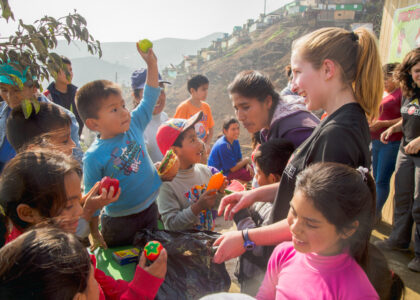
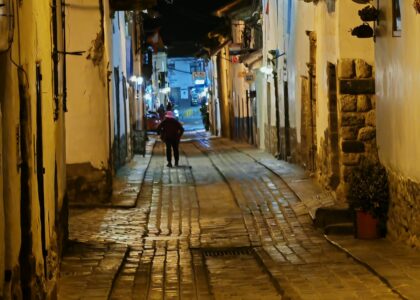
Engaged Education’s 8-day Lima and Cusco programs give students daily practice with Peruvian Spanish. In Lima, students take Spanish lessons on food vocabulary and art terms, then use them in a market challenge, a cooking class and the Barranco art district. In Cusco, interactive and conversational lessons connect to visits in the historic center, the Sacred Valley and Machu Picchu. In both cities, students visit MEDLIFE partner communities to learn about global health while practicing Spanish.
FAQ
Is Peruvian Spanish easy to understand?
Many learners find Peruvian Spanish, especially from Lima, easy to understand because speakers pronounce consonants clearly and speak at a moderate pace.
Do Peruvians use vosotros?
No. Peruvians use ustedes for “you all” in both formal and informal situations.
What is Andean Spanish?
Andean Spanish is the variety spoken in Peru’s highlands. It is influenced by Quechua in pronunciation, vocabulary and expressions.
Practice Peruvian Spanish in Peru
Peruvian Spanish gives learners a clear, welcoming place to build confidence. Our Language Immersion programs in Lima and Cusco combine Spanish lessons with real conversations. Fill out our form to learn more.
Start your journey by downloading the Engaged Education Brochure and learn more about our immersive programs in Peru, Spain, and beyond. Interested in creating lasting impact around the world? You can directly assist communities in need by becoming a monthly donor through MEDLIFE’s Moving Mountains initiative.