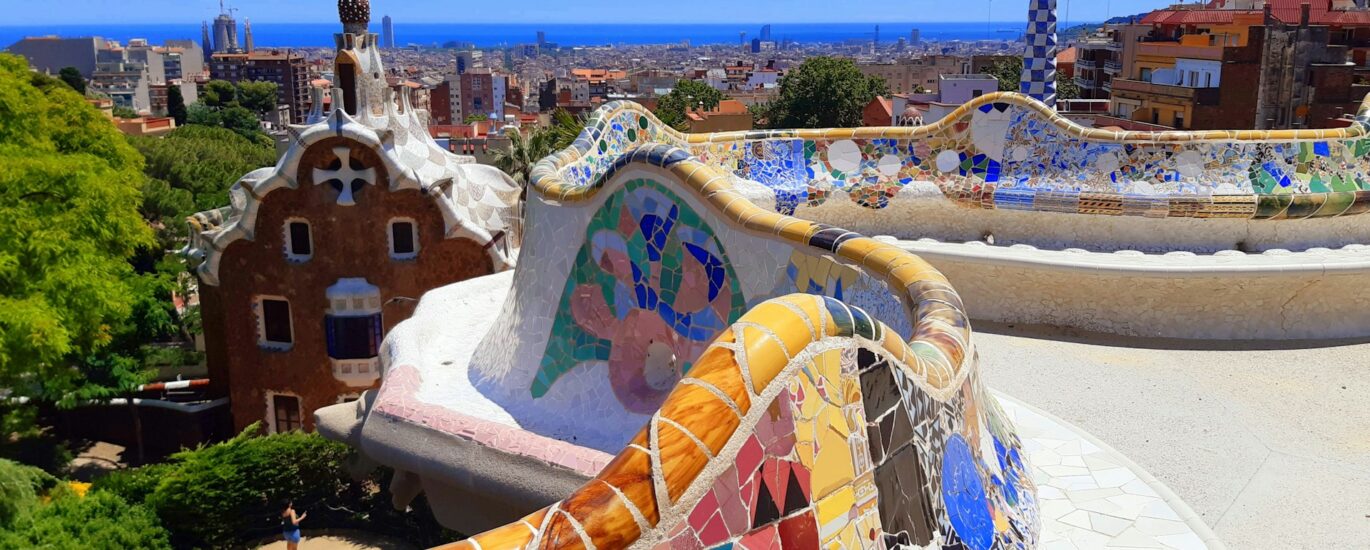
High on a hill above Barcelona, colorful mosaics, twisting columns and a famous tiled dragon greet visitors to Park Güell. Antoni Gaudí designed it in the early 20th century, and today it is one of the most visited places in the city. For students, Park Güell is a lesson in architecture, nature and urban planning, all in one walk.
This guide explains how Park Güell began, why it never became the housing project it was meant to be and what students should look for during a visit. You’ll also find classroom ideas that connect the park to art, math and Spanish. Park Güell is part of day two of Engaged Education’s Spain Global Impact Fellowship, together with the Sagrada Familia.
The history of Park Güell
A garden city that never was
In 1900, the businessman Eusebi Güell asked his friend Antoni Gaudí to design a private residential estate on a hillside called Muntanya Pelada. The plan was inspired by English garden cities. It included about 60 house plots, roads, a market hall and gardens.
Construction ran from 1900 to 1914. Very few people bought plots, and only two houses were built. One of them later became Gaudí’s home. He lived there for about twenty years before moving into his workshop at the Sagrada Familia.
From private estate to public park
After Güell’s death, his family offered the land to the city. Barcelona opened it as a public park in 1926. In 1984, UNESCO added Park Güell to its World Heritage listing for the works of Antoni Gaudí.
What to see at Park Güell
The park has a large free area of paths and gardens and a ticketed Monumental Zone with Gaudí’s best-known features. Entry to the Monumental Zone uses timed tickets.
The dragon stairway
The main staircase is guarded by a large lizard or dragon covered in broken tile mosaic. Locals call it el drac. It has become a symbol of Barcelona.
Trencadís mosaics
Gaudí and his collaborators covered surfaces with trencadís, a technique that uses broken pieces of ceramic and glass. Workers reused scraps from tile factories. Students can look for patterns, colors and recycled materials.
The Hypostyle Room
Below the main terrace stands a forest of columns that was planned as the estate’s market hall. The columns support the terrace above. The ceiling is decorated with round mosaic medallions.
The serpentine bench
The main terrace is lined with a long, wavy bench covered in mosaic. Architect Josep Maria Jujol worked closely with Gaudí on its decoration. The curves create small nooks where people can sit facing each other.
Viaducts and paths
Stone viaducts carry paths across the hillside. Their sloping columns look like tree trunks and were built with stone from the site. They show how Gaudí adapted construction to the land.
The Gaudí House Museum
The house where Gaudí lived now holds a small museum with furniture and objects he designed.
Teaching Park Güell in the classroom
Classroom ideas
- Nature in design: Show photos of the viaducts and columns. Ask students to find shapes taken from trees, caves or animals.
- Recycled art: Create a small trencadís mosaic with broken tiles or paper.
- Urban planning: Discuss why the garden city failed and what makes a neighborhood successful today.
- Geometry: Analyze curves and patterns in the serpentine bench.
- Spanish and Catalan: Teach words like el banco, el mosaico, el lagarto and the Catalan el drac.
Questions for discussion
- Why might a housing project fail even with a famous architect?
- How does reusing materials change the meaning of a building?
- What makes a public space welcoming?
For more on Gaudí, see our Sagrada Familia facts and our post on Gaudí architecture tours.
Visiting Park Güell with Engaged Education
On day two of the Spain Global Impact Fellowship, students take a guided walking tour of Barcelona’s historic center. They then visit the Sagrada Familia and Park Güell. Seeing both sites on the same day helps students compare Gaudí’s religious and residential work.
The rest of the Barcelona stay includes a day trip to Montserrat, a tapas cooking class with Mescladis and a waterfront bike tour. Students then take the high-speed train to Madrid. For practical tips, read our guide to things to do in Barcelona.
Tips for the visit
- Wear comfortable shoes. The park is on a steep hill with many slopes and stairs.
- Bring water and sun protection, especially in warm months.
- Follow timed entry. Groups need to arrive on time for the Monumental Zone.
- Stay with the group. Paths can be crowded.
FAQ
What is Park Güell?
Park Güell is a public park in Barcelona designed by Antoni Gaudí. It was built between 1900 and 1914 as a residential estate and opened as a public park in 1926.
Why is Park Güell famous?
It is famous for Gaudí’s mosaic dragon, the serpentine bench, the Hypostyle Room and its designs inspired by nature. It is part of a UNESCO World Heritage listing.
Do you need tickets for Park Güell?
The Monumental Zone, with Gaudí’s best-known features, requires timed tickets. Check the official website for current rules.
See Gaudí’s Barcelona with your class
Park Güell helps students see how architecture can work with nature and color. Our Spain Global Impact Fellowship 2027 is a 10-day program in Barcelona and Madrid built for high school groups. Fill out our form to learn more.
Start your journey by downloading the Engaged Education Brochure and learn more about our immersive programs in Spain and beyond. Interested in creating lasting impact around the world? You can directly assist communities in need by becoming a monthly donor through MEDLIFE’s Moving Mountains initiative.