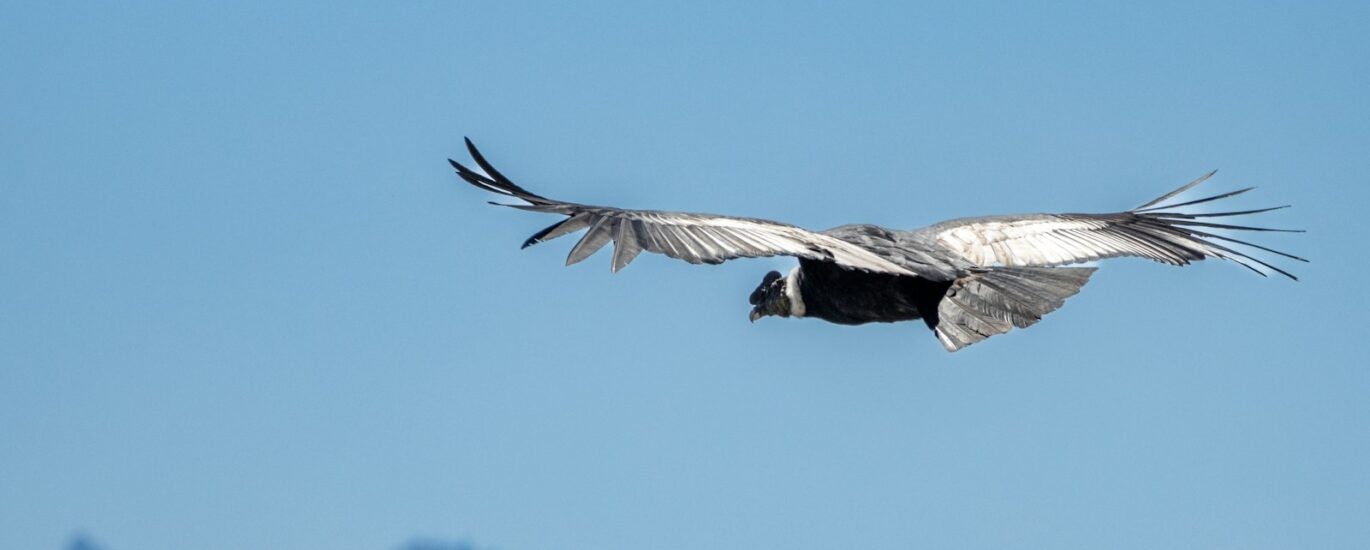
With wings stretched wider than a car is long, the Andean condor glides over mountain peaks for hours without flapping. It is one of the largest flying birds in the world and a powerful symbol in Andean culture. For the Inca and many Andean communities today, the condor connects the world of humans with the world above.
This guide shares key Andean condor facts, from its size and flight to its diet and conservation status. You’ll also learn what the condor means in Andean beliefs and where students can see its image in Peru, including a famous stone formation at Machu Picchu. We include classroom ideas for biology, social studies and Spanish. The condor makes a great bridge between science and culture before a trip to Cusco.
Andean condor facts
Size
The Andean condor, Vultur gryphus, is one of the heaviest flying birds in the world. Adults can weigh more than 11 kilograms. Their wingspan can reach about 3 meters, one of the largest of any land bird.
Appearance
Adults are mostly black with white patches on their wings and a ring of white feathers around the neck. Their heads are bare. Males have a fleshy crest on top of the head.
Range
Andean condors live along the Andes mountains of western South America and nearby coastal areas. They nest on rocky cliffs at high altitude.
Flight
Condors are masters of soaring. They ride rising warm air and wind over mountains to stay aloft. A study published in 2020 found that condors flapped their wings during only about 1 percent of their flight time.
Diet
Condors are scavengers. They feed on dead animals, such as livestock, deer and marine mammals on the coast. By cleaning up carcasses, they help keep ecosystems healthy.
Life cycle
Condors live a long time, often several decades. They reproduce slowly. A pair usually raises a single chick, and breeding may happen only every other year. This slow reproduction makes populations vulnerable.
Conservation status
The International Union for Conservation of Nature (IUCN) lists the Andean condor as Vulnerable. Main threats include:
- Poisoning, often from bait set for other animals
- Lead poisoning from eating animals shot with lead ammunition
- Habitat loss and human disturbance
- Persecution, based on mistaken beliefs that condors attack livestock
Conservation programs in several countries breed condors in captivity, release them and monitor wild populations.
The condor in Andean culture
The three worlds
In Andean cosmology, the world is often described in three levels. The condor is linked to Hanan Pacha, the upper world of the sky and the gods. The puma represents Kay Pacha, the world of the living. The snake represents Uku Pacha, the inner world of the dead and of seeds. Our post on Pachamama and Andean beliefs explains this worldview.
A messenger
Many Andean communities see the condor as a messenger between the earth and the sky, linked to the mountain spirits called apus.
The Condor Temple at Machu Picchu
At Machu Picchu, a group of carved and natural rocks is known as the Temple of the Condor. Many visitors see in the stones the shape of a condor with outstretched wings. Researchers still discuss its exact use. Read our post on who built Machu Picchu for more context.
Music and national symbols
The song “El Cóndor Pasa,” composed by Peruvian Daniel Alomía Robles, became famous around the world. The condor also appears on the coats of arms of several South American countries.
Classroom ideas
- Wingspan activity: Measure out 3 meters on the classroom floor to show a condor’s wingspan.
- Flight science: Discuss how thermals and wind help large birds soar.
- Conservation debate: Students propose ways to reduce threats to condors.
- Culture link: Students draw the three Andean worlds and their animals.
- Vocabulary: el cóndor, las alas, volar, planear, la montaña, en peligro.
For more Andean animals, see our guide to alpacas and llamas.
Andean culture on the Cusco program
On day six of Engaged Education’s 8-day Cusco program, students take a guided visit to Machu Picchu with a local guide. Earlier in the week, they explore Cusco’s historic center and Inca sites, attend a performance of Andean music and dance and visit the Sacred Valley. These experiences help students see how animals like the condor shaped Andean art and belief.
FAQ
How big is an Andean condor?
Adults can weigh more than 11 kilograms, and their wingspan can reach about 3 meters.
Is the Andean condor endangered?
The IUCN lists the Andean condor as Vulnerable. Threats include poisoning, lead and habitat loss.
What does the condor symbolize in Andean culture?
The condor represents Hanan Pacha, the upper world, and is seen as a messenger between the earth and the sky.
Explore Andean nature and culture
The Andean condor helps students connect biology with Andean beliefs. Our Language Immersion program in Cusco includes Inca sites, the Sacred Valley and a guided visit to Machu Picchu. Fill out our form to learn more.
Start your journey by downloading the Engaged Education Brochure and learn more about our immersive programs in Peru, Spain, and beyond. Interested in creating lasting impact around the world? You can directly assist communities in need by becoming a monthly donor through MEDLIFE’s Moving Mountains initiative.