
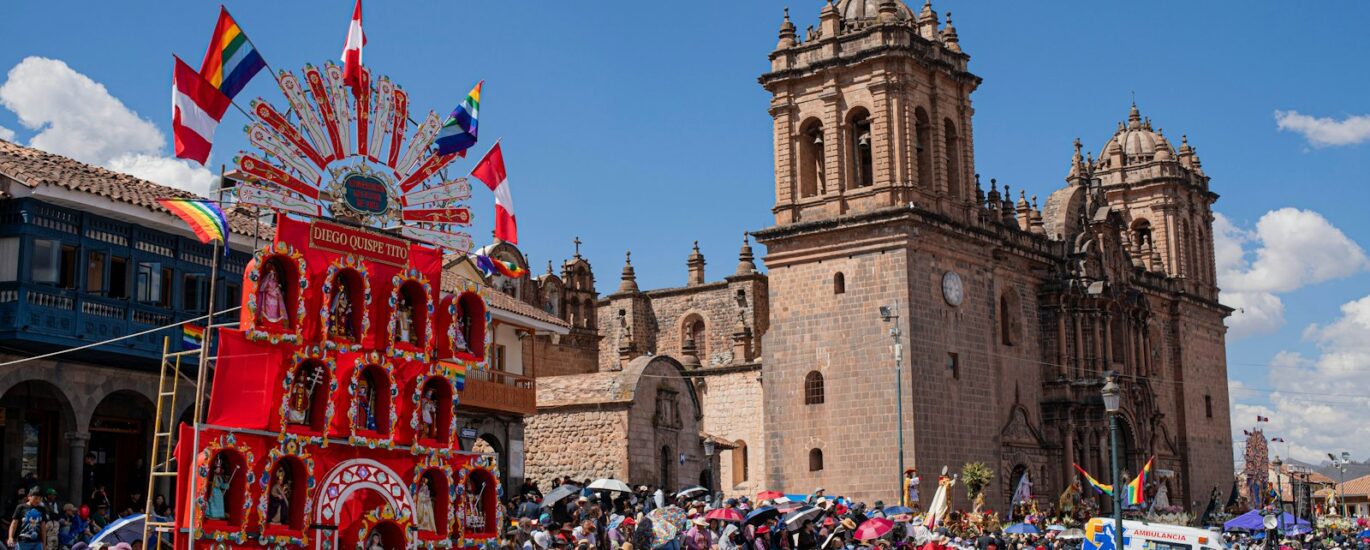
Every June 24, thousands of people gather in Cusco to watch a ceremony honoring the sun. Inti Raymi, the Festival of the Sun, is one of the best-known celebrations in Peru. It connects modern Cusco with its Inca past.
This guide explains where Inti Raymi comes from, how the modern festival works, and why it matters to people in Cusco today. It also includes classroom ideas for history, science, and Spanish teachers. Please note that this article is for background learning only. Our programs do not include the festival. At the end, we explain how students can experience Peruvian culture through our Cusco and Lima language immersion programs.
The History of Inti Raymi
Inti Raymi means “festival of the sun” in Quechua. Inti was the sun, one of the most important figures in Inca belief.
Origins in the Inca Empire
According to the chronicler Garcilaso de la Vega, the Inca ruler Pachacuti established the festival. It took place in Cusco, the capital of the empire, around the winter solstice. In the Southern Hemisphere, that is the shortest day of the year, in late June. The festival marked the start of a new year in the Inca calendar.
Ban and revival
After the Spanish conquest, colonial authorities and Catholic priests banned the festival. For centuries, it was not held in public.
In 1944, a group of Cusco intellectuals revived Inti Raymi as a historical reenactment. Quechua scholar Faustino Espinoza Navarro wrote the script and played the role of the Inca ruler in the first performance. The reenactment drew on the writings of Garcilaso de la Vega. Today the reenactment takes place each year on June 24.
National recognition
In 2001, Peru’s Congress declared Inti Raymi part of the Cultural Heritage of the Nation under Law No. 27431.
How the Inti Raymi Festival Works Today
The modern Inti Raymi festival takes place on June 24, which is also Cusco Day.
Three main stages
The ceremony moves through three locations in one day:
- Qorikancha, the former Inca Temple of the Sun, where the ceremony begins.
- Cusco’s Plaza de Armas, the main square, known in Inca times as Auqaypata.
- Sacsayhuaman, the archaeological park above the city, where the main ceremony takes place.
The performance
Hundreds of actors take part, according to Peru’s state news agency, Andina. Much of the performance is in Quechua. An actor plays the Sapa Inca, the ruler, who addresses the sun. Costumes, music, and dance recreate scenes described by colonial chroniclers.
Practical notes for visitors
The festival draws large crowds, and hotels in Cusco fill up early. Sacsayhuaman sits at about 3,700 meters above sea level, so altitude is a real consideration. Grandstand seating at Sacsayhuaman is sold in advance. Event details change each year, so visitors should check official, current sources before making plans.
Other Cusco festivals
Inti Raymi is one of several Cusco festivals. Andina calls it the largest event of the city’s jubilee month. Students can research other local celebrations and compare how each one connects to Cusco’s history.
Classroom ideas
- Science: explain why the solstice happens in June in the Southern Hemisphere and December in the north.
- History: compare the original Inca ceremony with the 1944 reenactment. Discuss what a historical revival can and cannot recreate.
- Spanish: read a short news article about the festival and summarize it.
- Social studies: discuss why a city might revive a tradition to celebrate its identity.
Experience Peruvian Culture on a Language Program
Inti Raymi shows how strongly Cusco values its heritage. Students can explore that heritage at other times of the year through our two Peru programs.
Language Immersion in Cusco
This 8-day program includes interactive Spanish lessons and visits to Cusco’s historic center, Sacsayhuaman, Puca Pucara, and Tambomachay. Students spend an evening at the Centro Qosqo de Arte Nativo, visit MEDLIFE partner communities to learn about global health, and travel to the Sacred Valley and Machu Picchu.
Language Immersion in Lima
This 8-day program focuses on coastal Peru. Students take Spanish classes, complete a market challenge, and join a cooking class. They visit Lima’s historic center and the Lugar de la Memoria (LUM). In Barranco, they explore the art district and join an Afro-Peruvian Music and Dance Workshop. A full-day excursion visits the Ballestas Islands and Huacachina.
Read more in our Peru language immersion guide, our list of things to do in Lima, and our Peru travel safety tips.
FAQ
When is Inti Raymi celebrated?
Inti Raymi is celebrated every year on June 24 in Cusco, Peru. The date is close to the winter solstice in the Southern Hemisphere and is also Cusco Day.
Where does Inti Raymi take place?
The ceremony moves through three places in Cusco: the Qorikancha, the Plaza de Armas, and the Sacsayhuaman archaeological park. The main ceremony takes place at Sacsayhuaman.
Is Inti Raymi an ancient festival?
Inti Raymi began in Inca times and was later banned under Spanish rule. The modern festival is a historical reenactment first staged in 1944.
Experience Peruvian Culture With Your Students
Inti Raymi is a window into how Cusco honors its Inca roots. Students can experience Peruvian culture firsthand through our Language Immersion in Cusco program, with Inca sites and the Sacred Valley, or our Language Immersion in Lima program, with markets, art, and Afro-Peruvian music. Fill out our form to learn more.
Start your journey by downloading the Engaged Education Brochure and learn more about our immersive programs in Peru, Spain, and beyond. Interested in creating lasting impact around the world? You can directly assist communities in need by becoming a monthly donor through MEDLIFE’s Moving Mountains initiative.