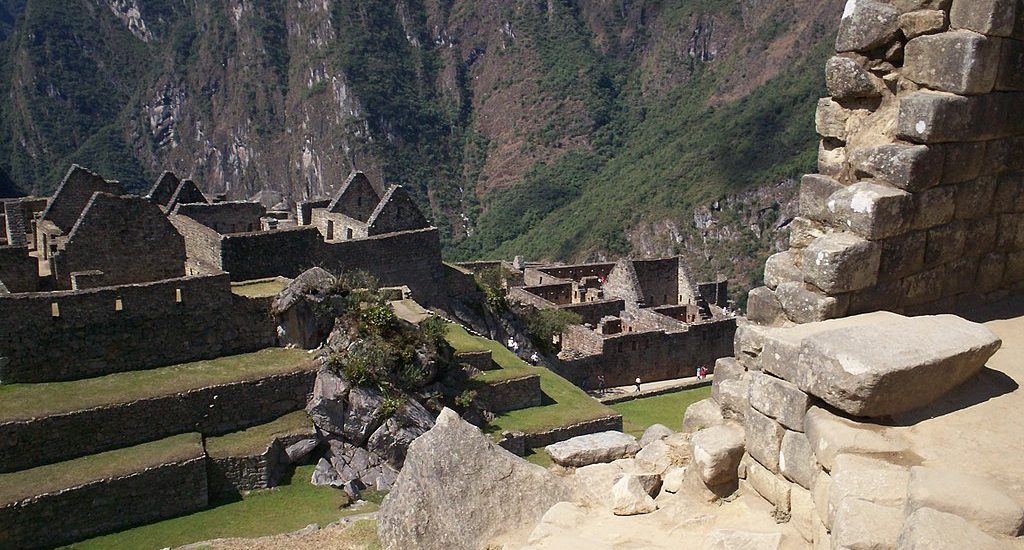
Machu Picchu sits on a narrow mountain ridge high above the Urubamba River, surrounded by steep green peaks and drifting clouds. It is one of the most famous archaeological sites in the world and a symbol of Peru. Many students know the classic photo. Fewer know how the site was built, what it was used for or how visits work today. These Machu Picchu facts help students arrive with context and good questions.
This guide shares fifteen facts grouped by topic: history, design, rediscovery and visiting. You’ll also find classroom ideas and vocabulary. Machu Picchu is a highlight of Engaged Education’s Cusco language immersion program, where students take the train to Aguas Calientes for a guided visit with a local guide.
Machu Picchu facts: history
1. It was built in the 15th century. Most archaeologists believe Machu Picchu was built around the mid-1400s, during the reign of the Inca ruler Pachacuti.
2. It was probably a royal estate. Many researchers think it served as a retreat for Inca royalty and nobles, with religious and ceremonial spaces.
3. Its name comes from Quechua. Machu Picchu is usually translated as “old mountain” or “old peak.” The ancient Inca name of the site is not certain.
4. It was used for less than a century. The site was abandoned around the time of the Spanish conquest in the 16th century.
5. The Spanish never recorded it. There is no clear evidence that Spanish colonizers ever reached the site, which helped preserve it.
Machu Picchu facts: design and engineering
6. It sits at about 2,430 meters. That is lower than Cusco, so many visitors find it easier to breathe there.
7. It has around 200 structures. These include temples, homes, storehouses and terraces, arranged in urban and agricultural sectors.
8. The walls fit without mortar. Inca masons cut stones so precisely that many walls fit together without any binding material.
9. Terraces protected the site. Agricultural terraces held soil, prevented landslides and drained heavy rains.
10. Water reached a chain of fountains. A stone canal carried spring water into the city to a series of 16 fountains.
Key places to know
- Temple of the Sun: A curved stone tower thought to have had astronomical uses.
- Temple of the Three Windows: A building with three large trapezoidal windows.
- Intihuatana: A carved stone often linked to astronomy and ceremony.
- Huayna Picchu: The steep peak behind the site, seen in classic photos.
Our post on who built Machu Picchu explores the site’s history in more depth.
Machu Picchu facts: rediscovery and recognition
11. Local families knew about it. Farmers in the area knew the site long before it became world-famous.
12. Hiram Bingham publicized it in 1911. The Yale lecturer was guided to the site by local residents. His reports and photos made it known internationally.
13. Artifacts returned to Peru. Objects taken to Yale University were returned to Peru in the 2010s after years of negotiation.
14. It is a UNESCO World Heritage Site. UNESCO listed the Historic Sanctuary of Machu Picchu in 1983 for both its cultural and natural value.
15. It is one of the New Seven Wonders. A global vote in 2007 named Machu Picchu one of the New Seven Wonders of the World.
Visiting Machu Picchu today
To protect the site, Peru limits daily visitors and uses timed tickets and set routes called circuits. Visitors usually reach the town of Aguas Calientes by train, then take a bus up the mountain. Rules change, so always check current information. Our guide on getting to Machu Picchu explains the logistics.
Classroom ideas
- Fact or myth: Students sort statements about Machu Picchu into facts and myths.
- Engineering challenge: Students build a model terrace and test drainage.
- Ethics discussion: Discuss who should own archaeological objects and why the Yale artifacts returned.
- Vocabulary: el sitio arqueológico, la montaña, las terrazas, el templo, el guía.
For background, see our Inca Empire facts.
Machu Picchu on the Cusco language immersion program
On day six of Engaged Education’s 8-day Cusco program, students take the train to Aguas Calientes for a guided visit to Machu Picchu. Train and bus tickets are included, and local guides lead the visit. Students return by evening train to Ollantaytambo. Earlier in the week, they take Spanish lessons, explore Cusco’s historic center and Inca sites above the city, visit MEDLIFE partner communities and spend a day in the Sacred Valley.
FAQ
How old is Machu Picchu?
Machu Picchu was built in the mid-15th century, so it is more than 500 years old.
What does Machu Picchu mean?
In Quechua, Machu Picchu is usually translated as “old mountain” or “old peak.”
How high is Machu Picchu?
Machu Picchu sits at about 2,430 meters above sea level, lower than the city of Cusco.
See Machu Picchu with your class
Machu Picchu brings Inca history, engineering and Andean culture together in one place. Our Language Immersion program in Cusco includes a guided visit to Machu Picchu along with Spanish lessons and cultural activities. Fill out our form to learn more.
Start your journey by downloading the Engaged Education Brochure and learn more about our immersive programs in Peru, Spain, and beyond. Interested in creating lasting impact around the world? You can directly assist communities in need by becoming a monthly donor through MEDLIFE’s Moving Mountains initiative.