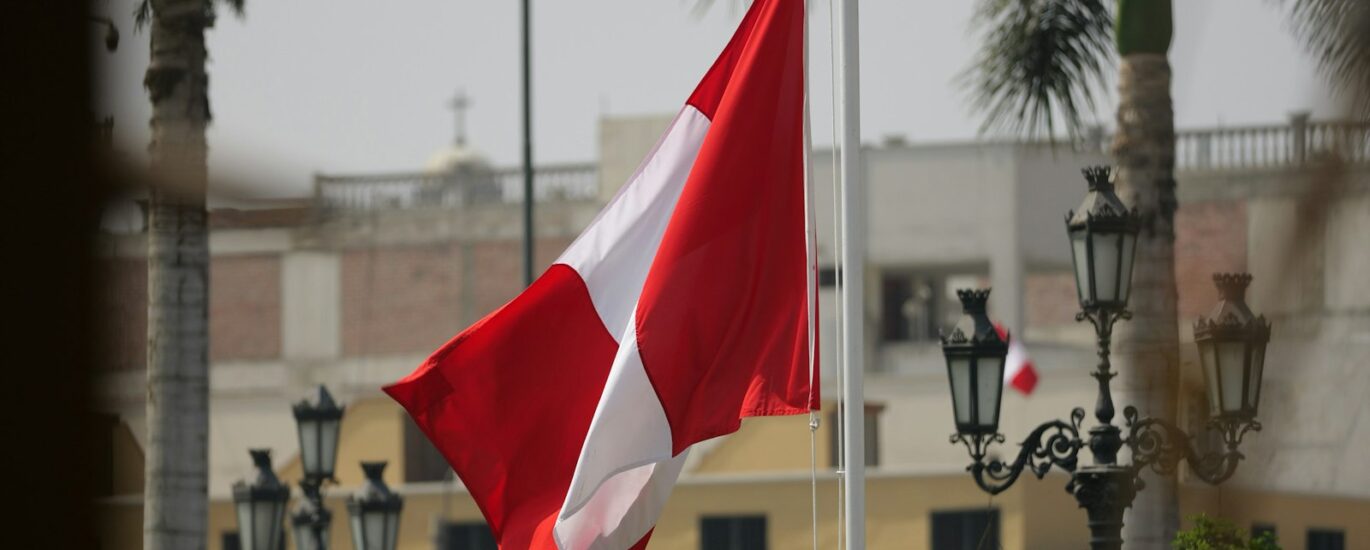
Red, white, red. The Peru flag is simple, but it carries a long history of independence, war and national identity. In July, it hangs from balconies, buses and shop windows across the country. In schools, students learn the story of its colors, and many repeat a legend about flamingos. Knowing the meaning of the flag helps students understand how Peruvians see their country.
This guide explains the history of the Peru flag, from its first design in 1820 to its current form. You’ll learn the difference between the plain flag and the versions with the coat of arms, what each symbol on the shield means and how Peru celebrates Flag Day. You’ll also find classroom ideas and vocabulary for Spanish and social studies.
What the Peru flag looks like
The Peru flag has three vertical stripes of equal width: red on the left, white in the middle and red on the right.
Three official versions
- Bandera Nacional: The plain red-white-red flag. Citizens fly it at homes and businesses.
- Pabellón Nacional: The same flag with the national coat of arms in the center. It is used by government institutions.
- Bandera de Guerra: The war flag, used by the armed forces, with a version of the coat of arms surrounded by flags and branches.
The history of the Peru flag
San Martín’s first flag (1820)
In 1820, General José de San Martín landed on Peru’s southern coast to fight for independence from Spain. He created the first Peruvian flag. It was divided diagonally into red and white sections, with a sun rising over mountains in the center.
Changes in the 1820s
In 1822, the design changed to horizontal stripes with a sun. Because it looked too similar to Spain’s flag from a distance, it was soon changed to vertical stripes. In 1825, Peru adopted the vertical red-white-red flag, close to the one used today.
The flamingo legend
A popular story says that San Martín, resting near the bay of Paracas, saw a flock of flamingos with red wings and white chests. He took the colors as a sign for the new nation. Historians consider this a legend. Other explanations link the colors to symbols used by earlier independence movements. The story is still loved and taught in many schools.
What the colors mean
There is no single official meaning. Many Peruvians describe red as the blood of those who fought for independence and white as peace, purity or justice.
The coat of arms
Peru’s national coat of arms is divided into three sections that represent the country’s natural wealth:
- The vicuña: A wild relative of the llama and alpaca, representing the animal kingdom.
- The cinchona tree: The source of quinine, an early treatment for malaria, representing the plant kingdom.
- A cornucopia spilling gold coins: Representing mineral wealth.
Our guide to alpacas and llamas also explains the vicuña.
Flag Day in Peru
Peru celebrates Flag Day, Día de la Bandera, on June 7. It commemorates the Battle of Arica in 1880, during the War of the Pacific, when Colonel Francisco Bolognesi and his troops defended the city. Schools hold ceremonies where students swear loyalty to the flag.
In July, before and during Fiestas Patrias, Peruvians fly the flag at homes and businesses. Our post on Peru Independence Day explains those celebrations.
Classroom ideas
- Design history: Students draw the 1820, 1822 and 1825 flags and describe the changes in Spanish.
- Legend vs evidence: Discuss the flamingo story and how historians test legends.
- Symbol study: Students explain each symbol on the coat of arms and design a coat of arms for their school.
- Compare flags: Compare Peru’s flag with the flags of the U.S., Canada and Spain.
- Vocabulary: la bandera, el escudo, las franjas, rojo, blanco, el símbolo, la independencia.
For more background, see our Peru facts for students.
Seeing national symbols on a Peru program
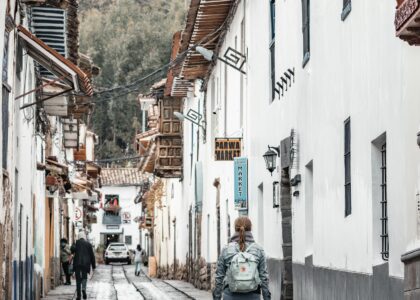
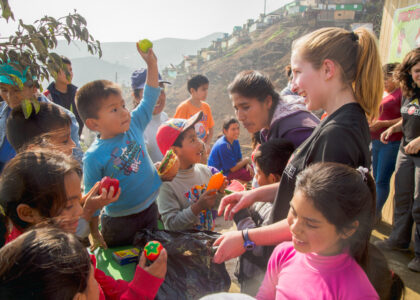
On Engaged Education’s 8-day Lima program, students explore Lima’s historic center on day four, including the main square where San Martín proclaimed independence in 1821. On the Cusco program, students see the flag at public buildings in the Plaza de Armas. Both programs include Spanish lessons, visits to MEDLIFE partner communities and cultural activities that help students understand Peruvian identity.
FAQ
What do the colors of the Peru flag mean?
There is no single official meaning. Red is often linked to the blood of independence fighters and white to peace and justice.
When was the current Peru flag adopted?
Peru adopted the vertical red-white-red design in 1825.
What is on the Peru coat of arms?
The coat of arms shows a vicuña, a cinchona tree and a cornucopia with gold coins, representing Peru’s animal, plant and mineral wealth.
Explore Peru’s identity with your class
The Peru flag helps students connect symbols with history and national pride. Our Language Immersion programs in Lima and Cusco combine Spanish lessons with historic sites and cultural activities. Fill out our form to learn more.
Start your journey by downloading the Engaged Education Brochure and learn more about our immersive programs in Peru, Spain, and beyond. Interested in creating lasting impact around the world? You can directly assist communities in need by becoming a monthly donor through MEDLIFE’s Moving Mountains initiative.