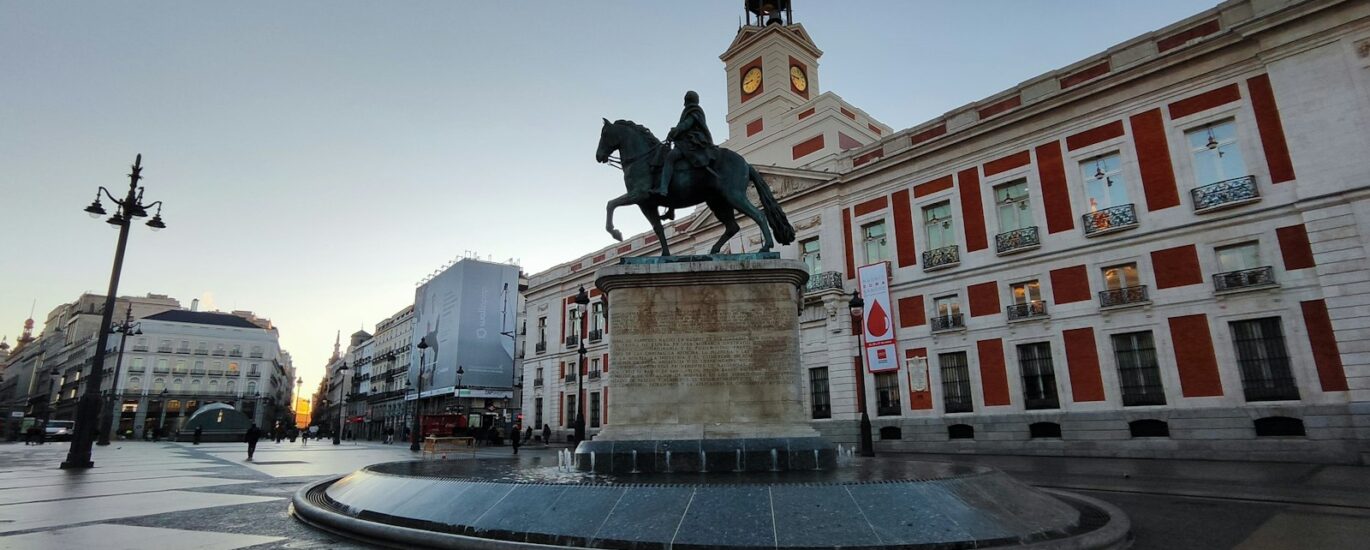
If Madrid has a heart, it beats in Puerta del Sol. Streets from every direction meet in this busy, half-moon-shaped square. Millions of Spaniards watch its clock on New Year’s Eve, and a small plaque on the pavement marks the point from which Spain’s national roads are measured. For students, Puerta del Sol is a place where history, politics and daily life overlap.
This guide covers the history of Puerta del Sol, from a medieval city gate to a modern meeting point. You’ll learn what students should look for, including Kilometer Zero, the famous clock and the bear and strawberry tree statue. You’ll also find classroom ideas and visiting tips. Puerta del Sol is part of the city tour on day seven of Engaged Education’s Spain Global Impact Fellowship.
The history of Puerta del Sol
A gate facing the sun
The name means “Gate of the Sun.” In the 15th century, one of the gates in Madrid’s walls stood here. A popular explanation says it faced east and was decorated with a sun. The walls disappeared as the city grew, but the name stayed.
The Royal Post Office
In the 18th century, King Charles III ordered the construction of the Real Casa de Correos, the Royal Post Office. This building still dominates the square. Over the years it has served as the Ministry of the Interior and, today, as the headquarters of the regional government of Madrid.
The 1808 uprising
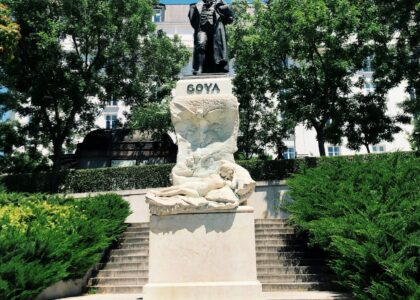
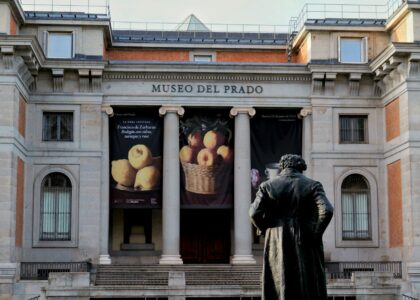
On May 2, 1808, people in Madrid rose up against French troops occupying the city. Fighting broke out in and around Puerta del Sol. The French responded with executions the next day. Francisco de Goya painted both events. His painting of the executions, The Third of May 1808, hangs in the Prado.
Protests and public life
Puerta del Sol has long been a place for public gatherings. In 2011, thousands of people camped in the square during the protests known as the 15-M movement, calling for political and economic change.
What to see in Puerta del Sol
Kilometer Zero
In front of the Royal Post Office, a plaque on the ground marks Kilómetro Cero. Spain’s main national roads are measured from this point. Many visitors stand on it for a photo.
The clock
The clock on top of the Royal Post Office is famous across Spain. On New Year’s Eve, crowds gather below it, and millions watch on television as Spaniards eat twelve grapes, one with each chime at midnight.
The bear and the strawberry tree
A bronze statue of a bear reaching up to a strawberry tree, el oso y el madroño, stands in the square. The image is a symbol of Madrid and appears on the city’s coat of arms.
Other landmarks
- Statue of Charles III: An equestrian statue honoring the king who modernized Madrid.
- The Mariblanca: A small statue of a woman, a copy of an older figure that once topped a fountain here.
- The Tío Pepe sign: A well-known neon advertisement for sherry that has become part of the skyline.
Teaching with Puerta del Sol
Classroom ideas
- Goya connection: Study The Third of May 1808 and discuss what happened in the square.
- Maps and roads: Look at a map of Spain’s radial road network starting from Kilometer Zero.
- Public squares: Compare Puerta del Sol with a public square in the students’ own city.
- New Year traditions: Teach the twelve grapes tradition and practice counting in Spanish.
Vocabulary
- la plaza: square
- el reloj: clock
- las campanadas: chimes
- el oso: bear
- el madroño: strawberry tree
For background, see our Madrid facts for students and our guide to Prado Museum masterpieces.
Puerta del Sol on the Spain Global Impact Fellowship
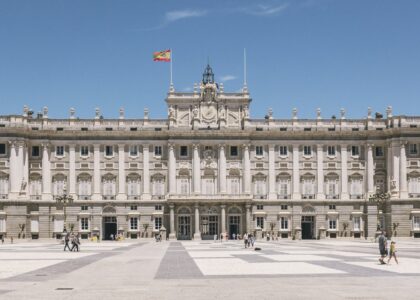
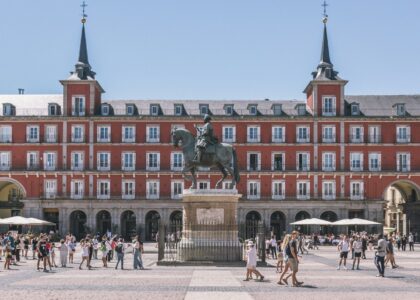
On day seven of Engaged Education’s Spain program, students take a city tour of Plaza Mayor, Puerta del Sol and the Royal Palace. They then take a guided visit to the Prado, where they can see Goya’s paintings of the 1808 uprising. On day eight, students join a Lavapiés street art workshop and prepare picnic bags for local children with a local NGO. Our list of things to do in Madrid adds more context.
Visiting tips
- Stay close to the group. The square is crowded at most hours.
- Keep valuables secure. Busy areas attract pickpockets.
- Pick a meeting point, such as the bear statue.
FAQ
What is Puerta del Sol known for?
Puerta del Sol is known for Kilometer Zero, the clock used for New Year’s Eve celebrations, the bear and strawberry tree statue and its role in Madrid’s history.
What is Kilometer Zero in Madrid?
Kilometer Zero is a plaque in Puerta del Sol that marks the point from which Spain’s main national roads are measured.
What happened in Puerta del Sol in 1808?
On May 2, 1808, Madrid residents rose up against French troops. Goya later painted the uprising and the executions that followed.
Walk through Madrid’s history with your class
Puerta del Sol helps students connect famous paintings and traditions to a real place. Our Spain Global Impact Fellowship 2027 is a 10-day program in Barcelona and Madrid built for high school groups. Fill out our form to learn more.
Start your journey by downloading the Engaged Education Brochure and learn more about our immersive programs in Spain and beyond. Interested in creating lasting impact around the world? You can directly assist communities in need by becoming a monthly donor through MEDLIFE’s Moving Mountains initiative.